Live Batches
Book Session
Menu
Curriculum
Account
Login / Sign Up
Live instructor-led

.NET Certification Training

Enroll in our .NET course online and become a certified .NET developer. Get hands-on training, real projects, and career support. Start your .NET training now!

Talk to a counsellor Watch preview

25
live sessions
4
modules
184
lessons
207
self-paced videos
Shailendra Chauhan
Your mentor Shailendra Chauhan Microsoft MVP, Founder & CEO at ScholarHat
25 live sessionsinstructor-led 4-module program40 topics Certificateon completion

.Net Tools and Technologies Covered

C#
C#
.NET Core
.NET Core
Math Problems
Math Problems
Logic Building
Logic Building
Code Debugging
Code Debugging
Code Flow
Code Flow
Star Patterns
Star Patterns
Arrays
Arrays
OOPs
OOPs
SQL Server
SQL Server
Visual Studio
Visual Studio

.NET Course Key Features

10 Weeks of Intensive Live Training

Interactive live sessions with expert instructors

Learn from Microsoft MVPs

Get trained by industry-recognized Microsoft experts

Build Food Delivery Real-World Website

Create a complete project for your portfolio

Hands-On Labs

Practice real scenarios with guided, interactive labs

Interview Q&A

Frequently asked interview questions with clear answers

Quick Notes

Concise revision notes for fast and effective learning

Why Learn .NET in 2025?

The future of .Net development is exceptionally bright, with a strong focus on cross-platform capabilities and cloud-based solutions.

  1. Flexibility and Diverse Career Paths: You could become a web developer, desktop application developer, or even specialize in game development.

  2. Financial Viability and Salary Prospects: .NET Professionals are among the higher earners. Entry-level developers earn an average of Rs.6–8 LPA, with experienced professionals earning upwards of Rs.18–25 LPA

  3. Demand for .Net Developers: From startups to Fortune 500 companies, there's a growing demand for skilled .Net developers.

  4. Web and Cloud Development: Microsoft Azure, a leading cloud platform, has over 200+ services integrated with .NET, enabling developers to build scalable and secure solutions.

  5. Cross-Platform Development: .NET developers can now build cross-platform applications that run on Windows, Linux, and macOS, as well as mobile applications with Xamarin.

~11X

Faster than Node.js

~3X

Faster than Java Servlet

~10M+

Developers across the world

4-22 LPA

.NET Core Developer Salary

~27K+

Jobs Available on LinkedIn

~18.5%

Developers use ASP.NET Core

.NET Career Scope in 2025

.NET Developer
ASP.NET Developer
Full-Stack .NET Developer
.NET Architect / Technical Lead
Cloud Transformation Lead
₹5.2 LPA
Avg package
35%
Avg hike
3,200+
Transitions
78%
Demand
Annual Salaries (₹)
₹5.5 LPA
Avg package
36%
Avg hike
3,200+
Transitions
75%
Demand
Annual Salaries (₹)
₹7.2 LPA
Avg package
40%
Avg hike
3,200+
Transitions
80%
Demand
Annual Salaries (₹)
₹17 LPA
Avg package
45%
Avg hike
3,200+
Transitions
70%
Demand
Annual Salaries (₹)
₹42 LPA
Avg package
80%
Avg hike
6,000+
Transitions
99%
Demand
Annual Salaries (₹)

Course Curriculum

  • 4 modules
  • 40 topics
  • 184 lessons
  • 25 live sessions
  1. Module 1 .NET and .NET Core 13 lessons
    • Understanding .NET Framework
    • .NET Framework Version History
    • .NET Framework 4.5 Architecture
    • Common Language Runtime (CLR)
    • CLR Components
    • Microsoft Intermediate language (MSIL)
    • Common Type System (CTS)
    • Common Language Specification (CLS)
    • Relationship Between CTS and CLS
    • Framework Class Library (FCL)
    • Just-In Time Compilation (JIT)
    • Types of JIT Compiler
    • Normal JIT, Pre-JIT, Econo JIT
  2. Module 2 C# Fundamentals 15 topics 68 lessons

    C# Programming Language

    • Introduction to C#
    • History of C# Version
    • C# Advantages

    Creating Your First C# Program

    • Structure of a C# Program
    • Basic Input / Output Operations
    • Compiling, Running, and Debugging

    Data Type

    • Understanding Data Type
    • Types of Data Type – Value Type & Reference Type

    Variable & Typecasting

    • Naming a variable
    • Boxing and Unboxing
    • Data Conversions – Implicit & Explicit
    • Safe Type Casting with IS and AS Operator

    Operators

    • Different Types of Operators
    • Operators precedence

    Conditional Statements

    • Introduction to conditional statement
    • If statements
    • If-else statement
    • If-else-if ladder
    • Switch statement

    Loops

    • Introduction to loop
    • ..while loop
    • while loop
    • for loop
    • foreach loop

    Jump Statements

    • break statement
    • continue statement
    • goto statement
    • return statement
    • throw statement

    Arrays

    • Introduction to Array
    • One Dimensional Array
    • Multi-Dimensional Array
    • Jagged Array
    • Array Class

    Strings

    • Introduction to strings
    • Mutable strings
    • Immutable strings
    • Strings methods
    • Verbatim String

    Introduction to Object-Oriented Programming

    • Object-Oriented Programming
    • Classes and Objects
    • Inheritance
    • Polymorphism
    • Abstraction
    • Encapsulation

    Class and Objects

    • Creating a class
    • Access Modifiers
    • Instance members
    • Creating an object

    Constructor and Destructor

    • Introduction to Constructor
    • Types of Constructor
    • Default Constructor
    • Parameterized Constructor
    • Introduction to Destructor
    • Creating Destructor

    Inheritance

    • Introduction to Inheritance
    • Types of inheritance
    • Advantage of Inheritance
    • Single Level Inheritance
    • Multi-Level Inheritance
    • Multiple Inheritance
    • Hybrid Inheritance

    Methods

    • Introduction to Methods
    • Method Parameters
    • Value, Out, Ref, Params and Optional Parameters
    • Methods Overloading
    • Methods Overriding
    • Method Hiding
  3. Module 3 Advanced C# 16 topics 64 lessons

    Property

    • Introduction to Property
    • Uses of Property
    • Types of Property
    • Read-Write Property
    • Read Only Property
    • Write Only Property

    Enum

    • Introduction to Enum
    • Creating Enum
    • Using Enum

    Exception Handling

    • Understanding Exceptions
    • Try, Catch and Finally block
    • Throw exception
    • Handling Exception
    • Custom Exception

    Attributes

    • Introduction to attributes
    • Creating attributes
    • Custom attributes

    Abstract Class

    • Introduction to Abstract Class
    • Creating Abstract class
    • Need of Abstract class
    • Advantages of abstract class

    Interface

    • Introduction to Interface
    • Creating Interface
    • Need of Interface
    • Abstract class vs. Interface

    Static Class

    • Introduction to static class
    • Creating static class and static methods
    • Need of static class
    • Normal class vs. Static class

    Partial Class

    • Introduction to partial class
    • Creating partial class
    • Need of partial class

    Anonymous Type, Dynamic Type and Tuples

    • Introduction to Anonymous Type
    • Using Anonymous Type
    • Introduction to Dynamic
    • Using Dynamic Type

    Anonymous Method and Lambda Expression

    • Introduction to Anonymous Method
    • Using Anonymous Method
    • Introduction to Lambda Expression
    • Types of Lambda Expression

    Delegates

    • Introduction to delegates
    • Types of delegates
    • Single Delegate
    • Multicast Delegate

    Events

    • Introduction to events
    • Creating Events
    • Event Handler

    Collections

    • Introduction to .NET Collections
    • Relations between Collection Interfaces and Classes

    Collection classes

    • ArrayList
    • SortedList
    • Dictionary
    • Hashtable
    • Stack
    • Queue

    Generics

    • Understanding .NET Generics
    • Generics Advantages
    • Collections vs. Generics

    Generics Collection Classes

    • List<T>
    • SortedList<TKey, TValue>
    • Dictionary<TKey, TValue>
    • Hashset<T>
    • Stack<T>
    • Queue<T>
  4. Module 4 SQL Server 9 topics 39 lessons

    SQL Server

    • Understanding SQL Server
    • SQL Server Version History
    • Advantage of SQL Server

    T - SQL

    • Types of SQL Commands
    • Creating Database
    • Altering Database
    • Deleting Database
    • Creating Table
    • Altering Table
    • Deleting Table

    SQL Keys, Commands and Clauses

    • Types of SQL Keys
    • Using SQL Commands
    • Querying Database
    • Delete vs. Truncate
    • SQL Operators
    • SQL Clauses

    SQL Joins

    • Types of Joins
    • Inner Join
    • Outer Join
    • Cross Join
    • Self-Join

    Views

    • Understanding Views
    • Need of Views
    • Creating, Altering and Dropping Views
    • Simple and Complex Views

    Functions

    • Built-In Functions
    • Scalar Functions
    • Aggregate Functions
    • Creating, Altering and Dropping Functions

    Stored Procedures

    • Creating, Altering and Dropping Procedure
    • Optional Parameters
    • Input and Output Parameters

    Triggers

    • Understanding Triggers
    • Stored Procedures VS Functions VS Triggers
    • Types of Triggers
    • Creating, Altering and Dropping Triggers

    Cursors

    • Understanding Cursors
    • Types of Cursors
    • Using Cursors
  • 15 modules
  • 207 videos
  • 17h 30m total
  1. Module 1.NET Fundamentals 27 videos 1h 24m

    .NET Platform

    • History of .NET Platform 0h 05m 59s
    • .NET Release Schedule 0h 02m 37s
    • Introduction to .NET Core 0h 05m 32s
    • .NET Performance 0h 01m 35s
    • Migrating .NET Framework Code to .NET Core 0h 07m 50s

    .NET Compilation

    • .NET Compilation 0h 02m 31s
    • Roslyn Compiler 02m 23s
    • Managed Code vs. Unmanaged Code 01m 08s
    • Microsoft Intermediate Language (MSIL/IL) 00m 55s
    • JIT Compiler & RyuJIT 01m 23s

    .NET CLI

    • Introduction to .NET CLI 0h 03m 05s
    • Working with .NET CLI 0h 07m 46s

    .NET Standard Library

    • .NET Standard Library 03m 20s
    • Demo :.NET, .NET Core and .NET Standard 07m 46s

    .NET Architecture

    • .NET 5: One .NET Vision 0h 03m 58s
    • .NET 4.x vs. .NET Core Architecture 0h 04m 45s

    .NET Architecture Components

    • .NET Architecture Components 01m 02s
    • Common Language Infrastructure (CLI) 01m 35s
    • Base Class Library (BCL) 01m 03s
    • Common Language Runtime (CLR) 02m 00s
    • Components of CLR 02m 43s
    • CTS & CLS 02m 23s

    Assembly and Garbage Collector

    • Assembly 03m 31s
    • Types of Assembly 02m 25s
    • Garbage Collector (GC) 00m 53s
    • Garbage Collector Generation 02m 00s
    • Garbage Collector Working 02m 11s
  2. Module 2Getting Started with C# 11 videos 58m

    Introduction to C#

    • Introduction to C# 0h 02m 41s
    • History of C# Version 0h 08m 22s
    • C# Code Execution 10m 04s

    Variable and Data Type

    • Variable 0h 02m 17s
    • Understanding Data Type 0h 02m 09s
    • Basic Input / Output Operations 0h 07m 52s
    • Types of Data Type – Value Type & Reference Type 0h 03m 23s
    • Type Casting or Type Conversions 0h 05m 57s
    • Safe Type Casting with IS and AS Operator 0h 09m 55s
    • Boxing and UnBoxing 0h 03m 16s
    • Boxing Unboxing vs. Type Casting 0h 02m 51s
  3. Module 3C# Conditional Statements and Loops 19 videos 1h 7m

    Operators and Conditional Statements

    • Different Types of Operators 0h 02m 45s
    • Operators Precedence 0h 04m 28s
    • Introduction to Conditional Statement 0h 01m 57s
    • If statements 0h 04m 17s
    • If-else statement 0h 03m 20s
    • If-else-if ladder 0h 03m 55s
    • Switch statement 0h 07m 04s
    • If-else ladder vs switch 0h 04m 26s

    Loops and Jump Statements

    • Loop Statements 0h 01m 08s
    • While Loop 05m 20s
    • For Loop 05m 19s
    • Do..While Loop 03m 36s
    • For each Loop 03m 25s
    • Jump Statements 00m 24s
    • Break Statements 04m 08s
    • Continue Statements 02m 36s
    • Goto Statements 03m 59s
    • Return Statements 02m 33s
    • Throw Statements 02m 41s
  4. Module 4C# Arrays and Strings 9 videos 46m

    Arrays

    • Arrays 0h 02m 32s
    • One Dimensional Array 0h 03m 45s
    • Multi Dimensional Array 11m 03s
    • Array Class 05m 44s
    • Jagged Array 04m 49s

    Strings

    • Strings 01m 14s
    • String Methods 10m 27s
    • Type of Strings 05m 06s
    • Verbatim String 01m 43s
  5. Module 5Object-Oriented Programming in C# 16 videos 1h 38m

    Object-Oriented Programming Concepts

    • Object-Oriented Programming 0h 03m 50s
    • Class and Object 05m 16s
    • Access Modifiers 17m 19s
    • Constructor 01m 16s
    • Default & Parameterized Constructors 08m 54s
    • Private and Static Constructors 11m 22s
    • Destructor 03m 58s
    • Destructor vs. Finalize 01m 28s

    Inheritance and Methods

    • Inheritance 0h 02m 11s
    • Types Of Inheritance 0h 07m 23s
    • Methods 0h 02m 08s
    • Method Overloading & Overriding 0h 08m 23s
    • Method Hiding 0h 02m 28s
    • Method Parameters 0h 14m 53s

    Structure

    • Structure 0h 04m 49s
    • Structure vs. Class 0h 03m 09s
  6. Module 6C#: Property, Indexer, Attributes and Exception Handling 8 videos 50m

    Property and Indexer

    • Property 0h 09m 47s
    • Type of Properties 0h 04m 37s
    • Indexer 0h 05m 03s

    Exception Handling

    • Exception Handling 0h 09m 39s
    • Custom Exception 0h 04m 33s

    Enum and Attributes

    • Enum 0h 07m 37s
    • Attributes 0h 04m 01s
    • Custom Attributes 0h 05m 16s
  7. Module 7C# Concepts: Abstract Class, Interface and Partial Class 11 videos 36m

    Abstract Class

    • Abstract Class 0h 03m 21s
    • Key Points About Abstract Class 02m 11s

    Interface

    • Interface 0h 05m 37s
    • Key Points About Interface 03m 00s
    • Interface vs. Abstract Class 04m 59s

    Static Class and Extension Method

    • Static Class 0h 03m 01s
    • Key Points About Static Class 01m 40s
    • Extension Method 0h 03m 35s
    • Key Points About Extension Method 01m 12s

    Partial Class and Partial Method

    • Partial Class, Interface or Struct 0h 04m 33s
    • Partial Methods 0h 03m 47s
  8. Module 8C# Concepts: Anonymous Type, Delegates, Events and Lambda 17 videos 46m

    Miscellaneous Types

    • Anonymous Type 0h 03m 53s
    • Key Points About Anonymous Type 01m 43s
    • Var Type 03m 03s
    • Object Type 02m 14s
    • Dynamic Type 03m 59s
    • Tuple 03m 59s

    Delegates and Events

    • Delegates 0h 02m 57s
    • Type of Delegates 01m 03s
    • When to Use Delegates 03m 29s
    • Events 02m 17s
    • When to Use Events 02m 40s

    Anonymous Method & Lambda Expression

    • Anonymous Method 0h 02m 46s
    • When to Use Anonymous Method 02m 37s
    • Lambda Expression 02m 20s
    • Type of Lambda Expression 02m 14s
    • When to Use Lambda Expression 02m 29s
    • Expression Tree 02m 48s
  9. Module 9C# Asynchronous Programming - Async and Await 13 videos 59m

    Asynchronous Programming in .NET

    • What is Synchronous and Asynchronous? 03m 53s
    • Asynchronous Programming Patterns In .NET 01m 04s
    • Asynchronous Programming Model (APM) 01m 57s
    • Event-based Asynchronous Pattern (EAP) 01m 28s

    Task-based Asynchronous Programming

    • Task-based Asynchronous Pattern (TAP) 02m 19s
    • Demo: Task-based Asynchronous Pattern (TAP) 12m 12s
    • Types of Tasks 02m 42s

    Async Return Types

    • Async Return Types 01m 12s
    • Demo: Async Return Types 12m 42s

    Async and Await in TAP

    • Async and Await in TAP 03m 07s
    • Demo: Async and Await 10m 10s

    Asynchronous vs. Multithreading

    • Asynchronous vs. Multithreading 04m 41s
    • Key Points about Asynchronous Programming 01m 34s
  10. Module 10Getting Started with SQL Server 19 videos 1h 20m

    Introduction to Database

    • Introduction to Database 0h 01m 46s

    Introduction to SQL Server

    • Introduction to SQL Server 01m 42s
    • Version History of SQL Server 0h 01m 29s
    • SQL Server Editions 0h 03m 59s

    Installing SQL Server and Components

    • Setting Up SQL Server 2019/2025 0h 04m 11s
    • Verifying SQL Server Environment 07m 16s
    • SQL Server Components and Services 04m 11s

    SQL Server Database and Tables

    • System Defined Databases 03m 00s
    • Creating A Database 04m 04s
    • Creating A Table 04m 14s

    SQL Keys

    • SQL Keys 07m 38s
    • Demo : SQL Keys 09m 06s

    SQL Commands

    • SQL Commands 01m 38s
    • Demo : DDL Commands 08m 39s
    • Demo : DML Commands 07m 16s
    • Demo : DQL Commands 02m 02s
    • Demo : DCL Commands 02m 53s

    SQL Constraints

    • SQL Constraints 02m 05s
    • Demo : SQL Constraints 03m 47s
  11. Module 11C# Features: v8 to v14 7 videos 1h 17m

    C# Features

    • C# 8.0 Features 0h 13m 11s
    • C# 9.0 Features 0h 14m 37s
    • C# 10.0 Features 0h 09m 39s
    • C# 11.0 Features 0h 10m 47s
    • C# 12.0 Features 0h 16m 31s
    • C# 13.0 Features 0h 07m 08s
    • C# 14.0 Features 0h 05m 50s
  12. Module 12T-SQL Fundamentals with SQL Server 22 videos 1h 29m

    Data Types, Variables and Operators

    • Data Types 0h 01m 15s
    • SQL Server Data Types 02m 48s
    • SQL Server Variables 03m 59s
    • SQL Server Operators 05m 39s

    SQL Server Control Of Flow

    • SQL Server Control Of Flow 01m 58s
    • Demo : SQL Server Control Of Flow 07m 42s

    SQL Query and Sub Query

    • SQL Query 04m 28s
    • SQL Sub Query 01m 58s

    SQL Clauses

    • SQL Clauses 02m 42s
    • Demo : SQL Clauses 06m 12s
    • SQL Clauses Order Of Execution 01m 45s

    SQL Predicates

    • SQL Predicates 01m 22s
    • Demo : SQL Predicates 06m 01s

    SQL Joins

    • SQL Joins 04m 07s
    • Demo : Inner Join 08m 20s
    • Demo : Outer Join 06m 56s
    • Demo : Cross Join 01m 48s
    • Demo : Self Join 04m 31s

    SQL Exceptions

    • SQL Exceptions 01m 56s
    • Demo : SQL Exceptions 07m 32s

    Try..Catch

    • Try..Catch in SQL Server 03m 22s
    • Demo : Try..Catch 02m 40s
  13. Module 13SQL Server Stored Procedures and Functions 10 videos 1h 35m

    Stored Procedure

    • Introduction to Stored Procedure 0h 06m 42s
    • Creating Stored Procedure 06m 50s
    • Stored Procedure Parameters 09m 17s
    • Stored Procedure Inserting Data 11m 46s
    • Stored Procedure Deleting Data 07m 58s
    • Stored Procedure Updating Data 10m 25s
    • Stored Procedure Encrypt Alter Rename Drop 08m 21s

    SQL Functions

    • Introduction to SQL Function 07m 21s
    • Scalar Functions 17m 42s
    • Table Valued Functions 09m 10s
  14. Module 14SQL Server Views and Indexes 6 videos 1h 8m

    SQL Server Views

    • Introduction to Views 0h 04m 49s
    • System Defined Views 07m 21s
    • Simple Views 16m 20s
    • Complex Views 13m 27s

    SQL Server Indexes

    • Clustered Index 17m 10s
    • Non-Clustered Index 09m 08s
  15. Module 15SQL Server Triggers and Cursors 12 videos 1h 30m

    SQL Server Triggers

    • Trigger Introduction Insert 0h 17m 37s
    • Update Trigger 06m 45s
    • Delete Trigger 03m 32s
    • Instead Of Trigger 06m 36s
    • logon trigger 08m 08s

    SQL Server Cursors

    • Introduction to Cursors 06m 18s
    • Static Cursor Example 08m 39s
    • Dynamic Cursor 09m 02s
    • Forward Only Cursor 07m 40s
    • Keyset Driver Cursor 06m 53s

    Cursor Alternatives

    • Cursor Alternatives (Part-1) 02m 16s
    • Cursor Alternatives (Part-2) 07m 28s
  1. 01 C# Basics 0:02:00
  2. 02 C# Variable and Data Type 0:04:00
  3. 03 C# Operators 0:02:30
  4. 04 C# Conditional Statements 0:02:30
  5. 05 C# Loops and Jump Statements 0:03:00
  6. 06 C# Arrays 0:02:15
  7. 07 C# Strings 0:02:00
  8. 08 Object-Oriented Programming Concepts in C# 0:05:00
  9. 09 C# Concepts: Abstract Class, Interface, Static Class & Partial Class 0:03:00
  10. 10 C#: Property, Indexer, Exception Handling & Enum 0:04:30
  11. 11 C# Miscellaneous Types 0:02:30
  12. 12 C# Delegates and Events 0:02:00
  13. 13 C#: Anonymous Method & Lambda Expression 0:02:00
  14. 14 C# Asynchronous Programming Async & Await 0:03:00
  15. 15 SQL Server Database and Tables 00:04:00
  16. 16 SQL Keys 00:03:00
  17. 17 SQL Commands 00:02:00
  18. 18 SQL Constraints 00:02:00
  19. 19 SQL Server Data Types & Variables 00:02:00
  20. 20 SQL Server Operators 00:02:00
  21. 21 SQL Server Control Of Flow 0:02:00
  22. 22 SQL Query and Sub Query 0:02:00
  23. 23 SQL Clauses 0:03:00
  24. 24 SQL Predicates 0:01:00
  25. 25 SQL Joins 0:02:00
  26. 26 SQL Exceptions 0:01:00
  27. 27 Try..Catch in SQL Server 00:03:00
  28. 28 SQL Server Views 00:02:00
  29. 29 SQL Server Indexes 00:02:00
  30. 30 SQL Server Stored Procedure 00:02:00
  31. 31 SQL Functions 00:02:00
  32. 32 SQL Server Triggers 00:02:00
  33. 33 SQL Server Cursors 00:01:00
  34. 34 ASP .Net Core - TDD and BDD 0:01:00
  35. 35 .NET Unit Testing Frameworks 0:01:00
  36. 36 Testing ASP.NET Core Application 0:01:00
  37. 37 Testing with NUnit and xUnit & VS Enterprise Edition 0:01:00
  1. 01 C#: Check Character Is Alphabet or Not 00:15:00
  2. 02 Implement Single-Cast Delegates in C# 00:20:00
  3. 03 C#: Calculate Area of Square 00:10:00
  4. 04 C#: Calculate Standard deviation 00:25:00
  5. 05 SQL Server: Primary Key 00:20:00
  6. 06 SQL Server: Joins 00:20:00
  7. 07 SQL Server: Triggers 00:40:00
  8. 08 SQL Server: Views 00:15:00
  9. 09 SQL Server: Distinct Clause 00:25:00
  10. 10 SQL Server: Stored Procedures 00:25:00
  11. 11 SQL Server: Order By Clause 00:35:00
  12. 12 C#: Swap Number With Second Variable 00:15:00
  13. 13 SQL Server: Indexes 00:30:00
  14. 14 SQL Server: Inner Join 00:25:00
  15. 15 SQL Server: Foreign Key 00:25:00
  16. 16 C#: Calculate the Average of Array Element 00:15:00
  17. 17 C#: Create A Student Class for Listing, Adding and Removing a Student 00:25:00
  18. 18 Create and Use Multicast Delegates in C# 00:20:00
  19. 19 C#: Check if a Number Is Even or Odd 00:15:00
  20. 20 C#: Check Number Is Positive or Negative 00:15:00
  21. 21 Implement Events in C# 00:20:00
  22. 22 C#: Create an Exception Class to Display a Custom Error Message Based On The Exception Type 00:25:00
  23. 23 C#: Swap Number Without Third Variable 00:15:00
  24. 24 C#: Find The Largest Element of an Array 00:10:00
  25. 25 SQL Server: Not Null Constraint 00:15:00
  26. 26 SQL Server: Self Join 00:25:00
  27. 27 SQL Server: Where Clause 00:35:00
  28. 28 SQL Server: Built-In Functions 00:40:00
  29. 29 SQL Server: Aggregate Functions 00:35:00
  30. 30 C#: Concatenate Two Arrays 00:15:00
  31. 31 SQL Server: Outer Join 00:30:00
  32. 32 SQL Server: Check Constraint 00:25:00
  33. 33 C#: Sum Of All Numbers 00:15:00
  34. 34 Working with Anonymous Methods and Lambda Expressions in C# 00:19:00
  35. 35 C#: Create Classes for Building Different Types Of Vehicles like Bikes, Scooters, Cars In A Factory 00:30:00
  36. 36 C#: Check Whether an Alphabet Is Vowel or Consonant 00:15:00
  37. 37 C#: Find the Largest Number among the Four Numbers 00:15:00
  38. 38 Using Lambda Expressions for Mathematical Operations in C# 00:20:00
  39. 39 C#: Create Classes for Employee 00:25:00
  40. 40 C#: Check if an Array contains a Given Values 00:15:00
  41. 41 SQL Server: Unique Constraint 00:15:00
  42. 42 SQL Server: Left Outer Join 00:15:00
  43. 43 SQL Server: Right Outer Join 00:20:00
  44. 44 SQL Server: Default Constraint 00:15:00
  45. 45 Sort Collections Using Lambda Expressions in C# 00:19:00
  46. 46 C#: Check if a String is Numeric 00:15:00
  47. 47 C#: Create Classes For Handling Different Bank Accounts (Saving and Current) Submit, Withdrawal 00:25:00
  48. 48 C#: Find the Factorial Of A Number Using Recursion 00:20:00
  49. 49 C#: Check whether a Year is Leap Year or Not 00:15:00
  50. 50 C#: Display the Fibonacci Series 00:15:00
  51. 51 C#: Convert Binary Numbers To Decimals 00:15:00
  52. 52 C#: Compare Two Strings 00:15:00
  53. 53 SQL Server: Insert Statement 00:20:00
  54. 54 SQL Server: Full Outer Join 00:15:00
  55. 55 Filter Data Using LINQ Where Clause in C# 00:20:00
  56. 56 Find Maximum and Minimum Values Using LINQ in C# 00:20:00
  57. 57 SQL Server: Operations on Joins 00:35:00
  58. 58 SQL Server: Select Statement 00:15:00
  59. 59 C#: Iterate through each Character of the String 00:15:00
  60. 60 C#: Display Armstrong Numbers Between Intervals 00:25:00
  61. 61 C#: Find the Highest Common Factor (HCF) or Greatest Common Factor (GCD) 00:15:00
  62. 62 C#: Find the Factorial of a Number 00:20:00
  63. 63 C#: Display Prime Numbers Between Intervals 00:15:00
  64. 64 C#: Check if a String is a palindrome or not 00:20:00
  65. 65 Group Records Using LINQ GroupBy in C# 00:20:00
  66. 66 Join Two Collections Using LINQ Join in C# 00:20:00
  67. 67 C#: Capitalize the first character of each Word in a String 00:20:00
  68. 68 C#: Reverse A Sentence Using Recursion 00:20:00
  69. 69 C#: Find the Lowest Common Multiple Factor (LCM) 00:20:00
  70. 70 C#: Check whether a Number is Palindrome Or Not 00:20:00
  71. 71 Project Data Using LINQ Select and SelectMany in C# 00:20:00
  72. 72 Find Duplicate Elements Using LINQ in C# 00:25:00
  73. 73 SQL Server: Subqueries 00:20:00
  74. 74 C#: To Check Number Is Armstrong Or Not 00:20:00
  75. 75 C#: To Check Number Is Prime Or Not 00:20:00
  76. 76 Implement Generic Classes in C# 00:20:00
  77. 77 C#: Count the Vowel and Consonants in A Sentence 00:20:00
  78. 78 C#: To Make A Calculator For Addition Subtraction Multiplication and Division Of Two Numbers 00:20:00
  79. 79 C#: To Print a table of a number using Loops 00:15:00
  80. 80 C#: Right Triangle Star Pattern 00:15:00
  81. 81 C#: Left Triangle Star Pattern 00:15:00
  82. 82 C#: Pyramid Star Pattern 00:15:00
  83. 83 C#: Diamond Star Pattern 00:15:00
  84. 84 C#: Right Triangle Number Pattern 00:15:00
  85. 85 C#: Right Triangle Repeat Number Pattern 00:15:00
  86. 86 C#: Pyramid Number Pattern (Asc) 00:19:00
  87. 87 C#: Pyramid Number Pattern (Desc) 00:20:00
  88. 88 C#: Pyramid Repeat Number Pattern 00:15:00
  89. 89 C#:Inverted Right Triangle Number Pattern (Asc) 00:15:00
  90. 90 C#: Inverted Right Triangle Number Pattern (Desc) 00:15:00
  91. 91 C#: Right Triangle Number Pattern (Asc) 00:15:00
  92. 92 C#: Right Triangle Number Pattern (Desc) 00:15:00
  93. 93 C#: Diamond Number Pattern 00:15:00
  94. 94 C#: Right Triangle Alphabetic Pattern 00:15:00
  95. 95 C#: Right Triangle Repeat Alphabet Pattern 00:15:00
  96. 96 C#: Pyramid Alphabet Pattern (Asc) 00:15:00
  97. 97 C#: Pyramid Alphabet Pattern (Desc) 00:15:00
  98. 98 C#: Pyramid Repeat Alphabet Pattern 00:15:00
  99. 99 C#: Inverted Right Triangle Alphabet Pattern 00:15:00
  100. 100 C#: Diamond Alphabet Pattern 00:15:00
  1. 01 .NET Skill Test 30 questions
  2. 02 .NET 10 Fundamentals & Architecture 15 questions
  3. 03 Introduction to SQL Server 15 questions
  4. 04 C# Arrays & Strings 15 questions
  5. 05 T-SQL Fundamentals with SQL Server 15 questions
  6. 06 C# 14 Programming with .NET 10 15 questions
  7. 07 ASP.NET Core 10 – Web & API Development 15 questions
  8. 08 SQL Server Views & Indexes 15 questions
  9. 09 SQL Server Stored Procedures & Functions 15 questions
  10. 10 Entity Framework Core 10 – Data Access 15 questions
  11. 11 Cloud-Native .NET 10 Applications 15 questions
  12. 12 SQL Server Triggers & Cursors 15 questions
  13. 13 Cross-Platform & Modern UI Development 15 questions
  14. 14 Introduction to C# 15 questions
  15. 15 C# Arrays & Strings 15 questions
  16. 16 OOPs in C# 15 questions
  17. 17 C# Concepts: Abstract Class, Interface & Partial Class 15 questions
  18. 18 C#: Property, Indexer, Attributes & Exception Handling 15 questions
  19. 19 C# Concepts: Anonymous Type, Delegates, Events & Lambda 15 questions
  20. 20 C# Asynchronous Programming: Async & Await 15 questions
  21. 21 Introduction to SQL Server 15 questions
  22. 22 T-SQL Fundamentals with SQL Server 15 questions
  23. 23 SQL Server Views & Indexes 15 questions
  24. 24 SQL Server Stored Procedures & Functions 15 questions
  25. 25 SQL Server Triggers & Cursors 15 questions
  1. Q&A guide.NET Fundamentals 9 questions
    • Introduction to .NET 4.x 0:20:00
    • Garbage Collector 0:30:00
    • .NET CLI 0:30:00
    • .NET Standard 0:30:00
    • VS Code with .NET Core 0:30:00
    • Porting .NET to .NET Core 0:30:00
    • .NET Versions 0:30:00
    • .NET Core SDK and Compilation 0:30:00
    • Core CLR and RyuJIT 0:30:00
  2. Q&A guideGetting Started with C# 4 questions
    • Introduction to C# 2:00:00
    • C# Data Types 2:00:00
    • Operators in C# 2:00:00
    • Keywords and Type Conversions in C# 2:00:00
  3. Q&A guideC# Conditional Statements and Loops 3 questions
    • Decision-Making Statements in C# 2:00:00
    • Loops in C# 2:00:00
    • Jump and Other Statements in C# 2:00:00
  4. Q&A guideC# Arrays and Strings 2 questions
    • Arrays in C# 2:00:00
    • String in C# 2:00:00
  5. Q&A guideObject-Oriented Programming in C# 4 questions
    • Class, Object, Constructors, and Destructors in C# 2:00:00
    • Access Modifiers, and Static Classes in C# 2:00:00
    • Enums, Structures in C# 2:00:00
    • Collections and Generics in C# 2:00:00
  6. Q&A guideC#: Property, Indexer, Attributes and Exception Handling 3 questions
    • Exception Handling in C# 2:00:00
    • Reflection and Serialization in C# 2:00:00
    • Property and Indexer in C# 2:00:00
  7. Q&A guideC# Concepts: Abstract Class, Interface and Partial Class 2 questions
    • Function Pointers, Partial Classes, and Static Methods in C# 2:00:00
    • Abstract Class and Interface in C# 2:00:00
  8. Q&A guideC# Concepts: Anonymous Type, Delegates, Events and Lambda 1 questions
    • Delegates and Events in C# 2:00:00
  9. Q&A guideC# Asynchronous Programming - Async and Await 1 questions
    • C# Threading 2:00:00
  10. Q&A guideGetting Started with SQL Server 5 questions
    • Introduction, Installation, and Configuration of SQL Server 0:20:00
    • SQL Server Databases and Tables 0:17:00
    • SQL Keys and Relationships 0:15:00
    • SQL Commands and Data Operations 0:18:00
    • SQL Constraints and Data Integrity 0:19:00
  11. Q&A guideC# Features: v8 to v14 1 questions
    • Modern C# Features and Language Enhancements 0:20:00
  12. Q&A guideT-SQL Fundamentals with SQL Server 5 questions
    • SQL Server Data Types, Variables and Operators 0:20:00
    • Control Flow and Error Handling in T-SQL 0:16:00
    • SQL Queries, Subqueries and Clauses 0:19:00
    • SQL Predicates and Filtering Techniques 0:15:00
    • SQL Joins and Data Retrieval Techniques 0:17:00

.NET Course Eligibility

Pre-requisites

There are no prerequisites to join .NET certification training. Although having the basic knowledge and understanding of programming will be helpful.

Who can Join?

This course is recommended for any students, beginners and freshers interested in creating .NET-based applications.

  1. Beginners in Coding: Perfect for those starting their coding journey, .NET courses provide a solid foundation.
  2. Experienced Developers: If you're coming from other languages, .NET helps diversify your skill set.
  3. Web Developers: Ideal for those wanting to build robust web applications using ASP.NET.
  4. Desktop App Developers: Explore .NET, especially WPF, for creating powerful desktop applications.
  5. Mobile App Developers: Xamarin, part of .NET, allows you to develop cross-platform mobile apps.
  6. IT Pros and Administrators: Learn .NET, particularly PowerShell, for automation and system tasks.
  7. Entrepreneurs and Enthusiasts: Gain valuable skills for developing software solutions and tech understanding.

OUR ALUMNI WORK AT

Trusted by learners whose careers now thrive at leading companies

Choose Training Options

50% OFF
Live Training

Live, expert-led classes mapped to your certification.

₹19,999 ₹9,999
12 months access to the course
What you get
Live Sessions 25
Skill Tests 25
30% OFF
Corporate Training

Tailored team training for your organization.

₹24,284 ₹16,999
Minimum 5 users
Includes
Live Sessions
Custom Content
Flexible Schedule
Labs & Tests
Real Projects
24x7 LMS Access
Trusted by 2,00,000+ Thought Developers, Tech Leads and Architects

.NET Career & Certification

To become a .NET developer, learn C# programming language and gain proficiency in .NET Core, C#, OOPs, advanced C# and SQL Server. Study databases and then try to build projects to apply your skills. Seek the best .NET training, consider certifications, and then apply for entry-level .NET developer positions.

Throughout the .NET Certification training, participants will dive into the world of .NET Core, learning basics to advanced concepts. They will gain a solid understanding of C#, OOPs, advanced C#, and SQL Server, as well as master the art of developing web applications using .NET.

.NET training is ideal for aspiring software developers, programmers, and IT professionals who want to specialize in Microsoft's .NET technology stack. It's suitable for beginners looking to enter the field and experienced developers aiming to upgrade their skills in .NET Core, C#, OOPs, advanced C#, and SQL Server to build scalable and secure applications.

There are no strict prerequisites for .NET training, but familiarity with a programming language like C# and databases like SQL Server or prior experience in software development can be beneficial. It's open to individuals looking to start a career in .NET development or enhance their existing skills.

Yes, you can switch from self-paced training to instructor-led training. For that, you need to be in touch with the counselor. Contact on +91-999 9123 502 or email us at hello@scholarhat.com.

Some console-based projects like Contact Book, Calculator, etc., are included as part of the .NET certification.
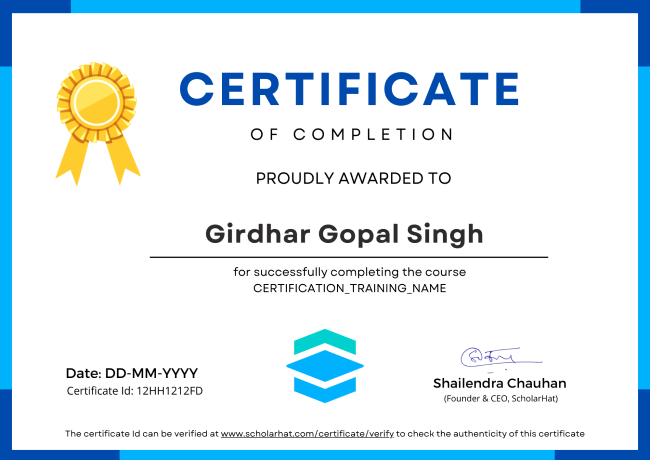

Verifiable Credential .NET Career & Certification certificate

Course Mentors

Shailendra Chauhan
11X MICROSOFT MVP AI ARCHITECT

Shailendra Chauhan

Microsoft MVP, Founder & CEO at ScholarHat

17+ Years of Industry Experience as Mentor & Solution Architect
Expert in .NET, Angular, React & Python
Azure Cloud & AI/ML/Gen AI Specialist
Bhawna Gunwani

Bhawna Gunwani

Corporate Trainer

15+ Years Technical & Corporate Training
Expert in Microsoft Tech, React, Angular & Node
Global Training: TCS, Infosys, Accenture & More

Frequently Asked Questions

Q1. Who is this .NET course for?
This course is ideal for beginners, software developers, and IT professionals who want to build scalable web applications, enterprise solutions, and cloud-based applications using .NET.
Q2. Does this course cover the latest .NET 8 features?
Yes! The course includes .NET 8 advancements such as performance improvements, API updates, and cloud-native development with Azure.
Q3. Will I get hands-on projects and real-time experience?
Absolutely! You will work on industry-relevant projects, including e-commerce apps, financial applications, and microservices-based architectures.
Q4. How does this course help in career growth?
With .NET skills in high demand, this course prepares you for roles like .NET Developer, Full-Stack Developer, Cloud Engineer, and Software Architect, boosting your job prospects.
Q5. What are the job roles available after getting a .net certification?
One of the most common job roles after .net certification is that of a .net developer. With the skills gained through .net training, you can also explore job roles such as Software Engineer, Software Consultant, Systems Analyst, or even Project Manager, depending on your interests.
Q6. What does a .net developer do?
A .net developer is responsible for designing, developing, and implementing software solutions using the .net framework. They creates web applications, desktop applications, and mobile applications using languages like .NET core, C# and SQL Server.
Q7. Is .net programming a good career option?
.NET programming is definitely a good career option. With the growing demand for software developers and the increasing popularity of the .net framework, there is a great scope for .net programmers in the job market. The demand for .NET programmers is constantly growing, which means plenty of job opportunities and a promising future.
Q8. What is the scope of .Net Core or .NET8?
The new .Net versions have the features such as Enhanced Security, Long-term support version (LTS), Hot Reload, Unified platform with improved browser speed, cloud compatibility, adaptability, and IoT performance it has a long-time persistence in the field of software development.
Q9. What are the benefits of joining the Scholarhat .Net Certification Training Program?
Benefits of joining the Scholarhat .NET Certification Training Program include expert-led training, hands-on projects, industry-relevant curriculum, certification, placement assistance, and a supportive learning community.
Q10. What is the salary for a .NET Certified Professional?
The salary for a .NET Certified Professional in India can vary based on factors like experience, location, and employer. On average, it can range from ₹4,00,000 to ₹10,00,000 per year or more.
Q1. What is the Azure AI Cloud Sandbox?
The Azure AI Cloud Sandbox is a secure, isolated environment that lets you practice and experiment with Azure AI services without affecting production resources. It provides hands-on access to real Azure AI capabilities in a risk-free setup.
Q2. Can I Attend a Demo Session before Enrolment?
Yes, you can Attend a Demo Session before Enrolment in angular certification course. It gives you the opportunity to assess whether the training program aligns with your learning objectives. So, don't hesitate! Take advantage of this opportunity and attend a demo session before making your decision.
Q3. Can I request for a support session if I need to better understand the topics?
Yes, of course you can request for a support session if you need to better understand the topics. For that, you need to be in touch with the counsellor. Contact on +91- 999 9123 502 or you can mail us at hello@scholarhat.com
Q4. Who are your mentors?
All our mentors are highly qualified and experience professionals. All have at least 8-10 yrs of development experience in various technologies and are trained by ScholarHat to deliver interactive training to the participants.
Q5. What If I miss my online training class?
All online training classes are recorded. You will get the recorded sessions so that you can watch the online classes when you want. Also, you can join other class to do your missing classes.
Q6. Can I share my course with someone else?
In short, no. Check our licensing that you agree to by using ScholarHat LMS. We track this stuff, any abuse of copyright is taken seriously. Thanks for your understanding on this one.
Q7. Do you provide any course material or live session videos?
Yes we do. You will get access to the entire content including class videos, mockups, and assignments through LMS.
Q8. Do you provide training on latest technology version?
Yes we do. As the technology upgrades we do update our content and provide your training on latest version of that technology.
Q9. Do you prepare me for the job interview?
Yes, we do. We will discuss all possible technical interview questions and answers during the training program so that you can prepare yourself for interview.
Q10. Will I get placement assistance after receiving my course completion certificate?
Yes, you’ll get placement assistance after receiving your course completion certificate. The placement assistance provided by the US will guide you through the job search process, help you polish your resume, and connect you with potential employers. For that, you need to be in touch with the counsellor. Contact on +91- 999 9123 502 or you can mail us at hello@scholarhat.com
Still have some questions? Let's discuss.
CONTACT US