✨ Hybrid Program (Live Mentorship + Self-paced Learning)
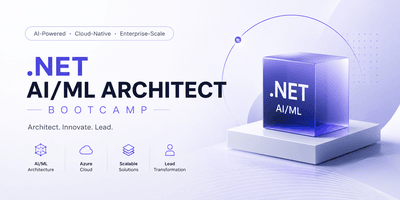
.NET AI/ML Architect Bootcamp
15 Weeks Hybrid Bootcamp with Mentor-Led Doubt Sessions. Master .NET AI/ML, Azure, Software Architecture, System Design, Microservices, Docker/K8s & DevOps — and prepare for high-paying roles up to ₹45 LPA at top MNCs.
Career-Focused Curriculum
6 - Real Projects
Job Assistance
Course Preview
₹45 LPA
Avg. .NET Architect Salary
20K+
Open Jobs on LinkedIn
2.5M
AI/ML Career Opportunities
10M+
Developers Worldwide
Why Software Architecture + System Design + AI/ML Is a Career Edge?
Master software architecture, system design, microservices, cloud, docker/k8s and AI/ML—the combination of skills that companies are actively hiring for.
High-paying opportunities
Become ready for architect & leadership roles in modern .NET ecosystems.
~45 LPA Target Salary
Strong global demand
Thousands of AI-driven .NET roles are actively hiring across global companies.
~18K+ Jobs on LinkedIn
Growing market demand
Demand for AI-powered .NET and cloud engineering continues to rise globally.
~30% Demand Growth
Massive AI/ML opportunity
AI-powered applications and intelligent systems are creating huge career demand.
~2.5M AI/ML Opportunities
Everything you get inside the bootcamp
scholarhat.comReal screen
6 Real-World Projects
Build production-grade, recruiter-ready projects with real-world architecture.
ScholarJobs
AI-Powered Job Hunting Platform
ASP.NET CoreOcelot APIAzureCI/CD
Build a recruiter-ready job portal with job applications, employer dashboards, profile management and CI/CD deployment.
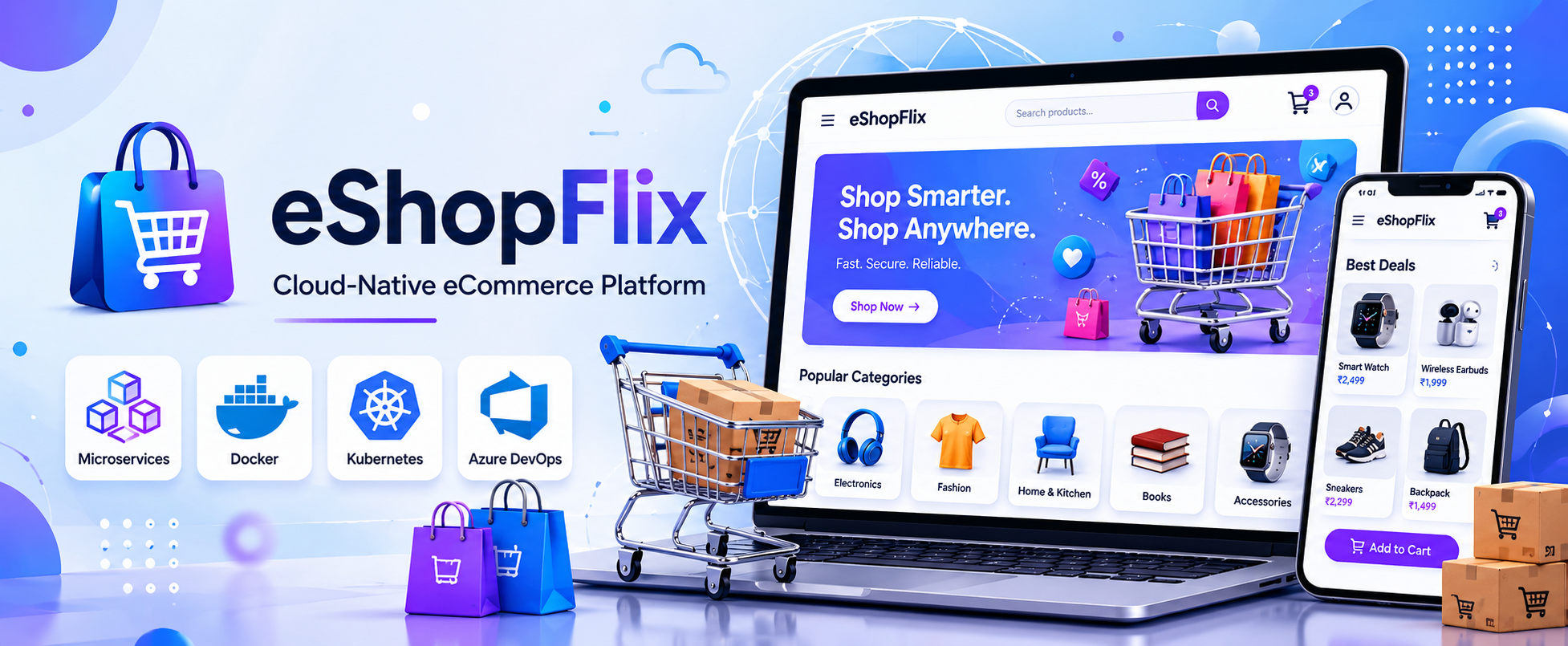
eShopFlix
Cloud-Native eCommerce Platform
MicroservicesDockerKubernetesAzure DevOps
Build a scalable eCommerce platform using microservices, Docker, Kubernetes, API Gateway and cloud-native architecture.
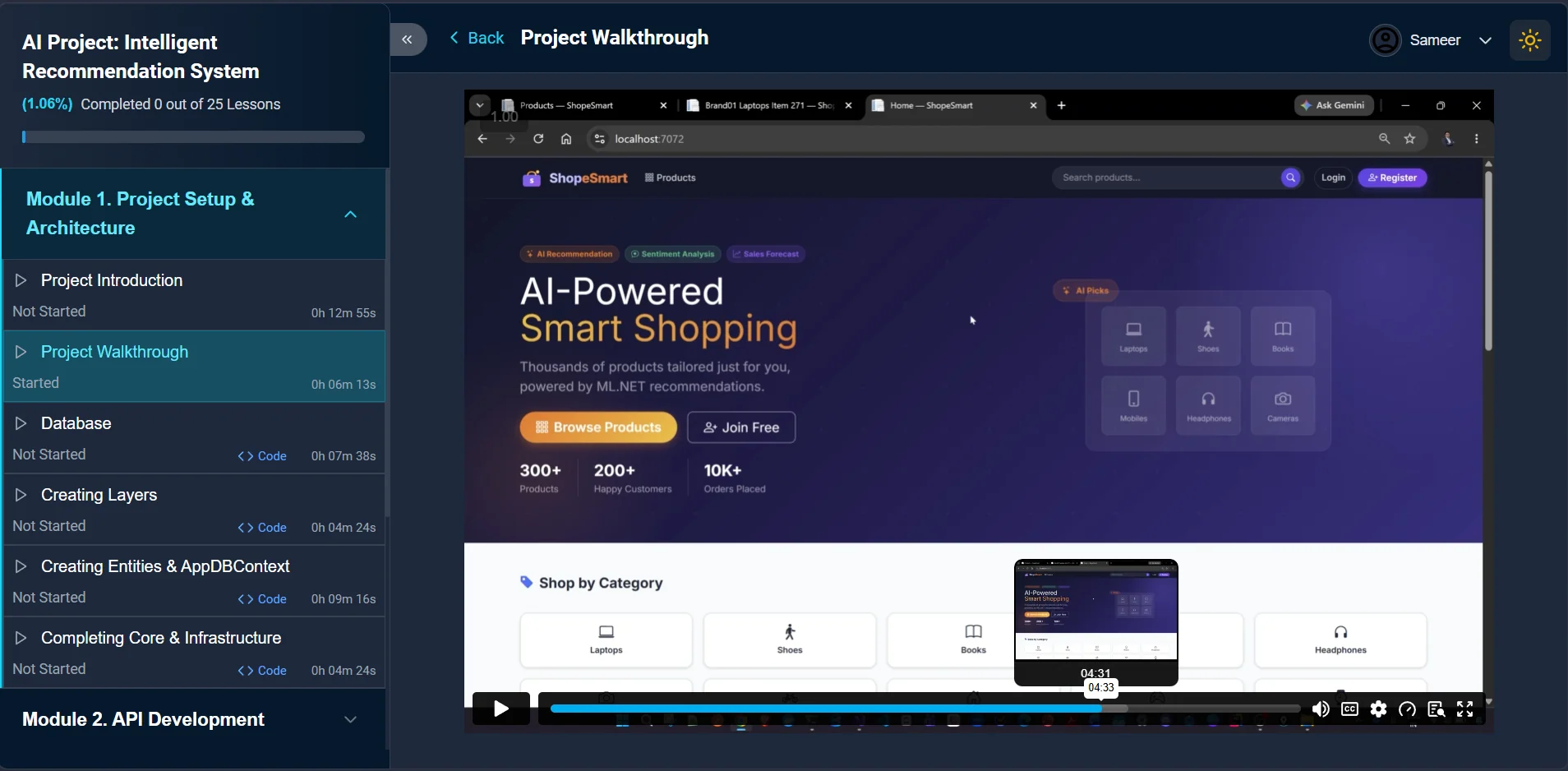
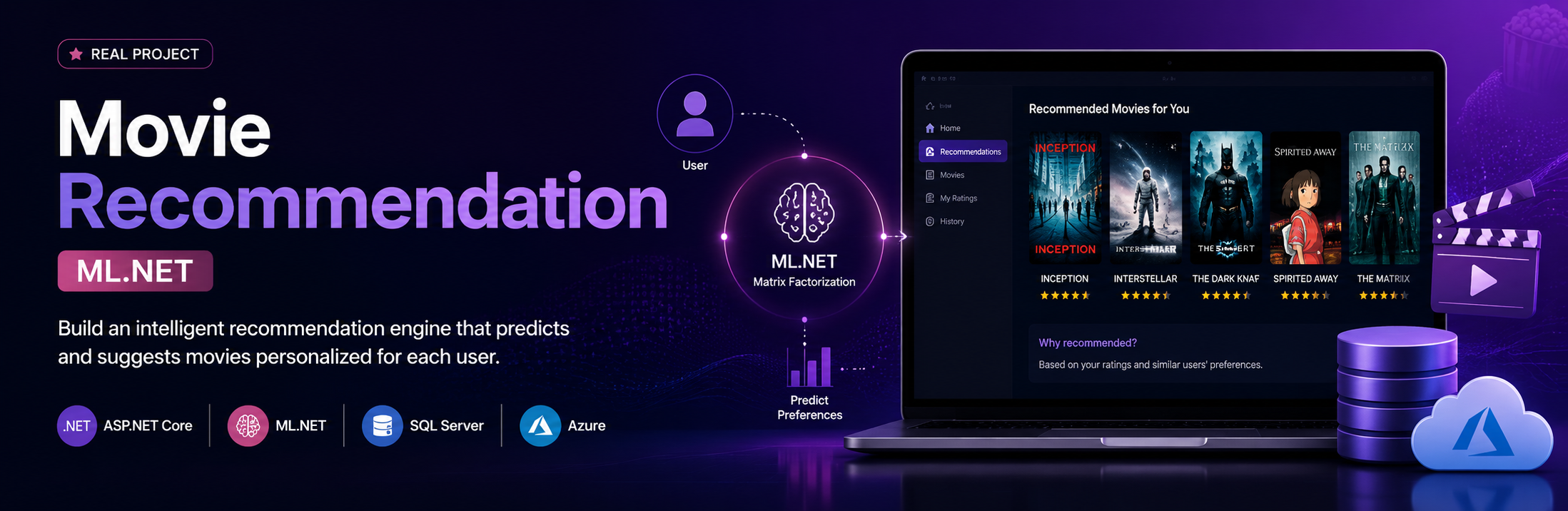
Movie Recommendation
AI-Powered Recommendation Engine
ASP.NET CoreML.NETSQL ServerAzure
Build an intelligent movie recommendation system using ML.NET Matrix Factorization to deliver personalized suggestions based on user behavior, ratings, and interactions.
eVideo Prime
OTT Streaming Platform Deployment
ReactREST APILazy LoadingJWT
Build a Netflix-style OTT platform with streaming UI, authentication, APIs and content delivery.
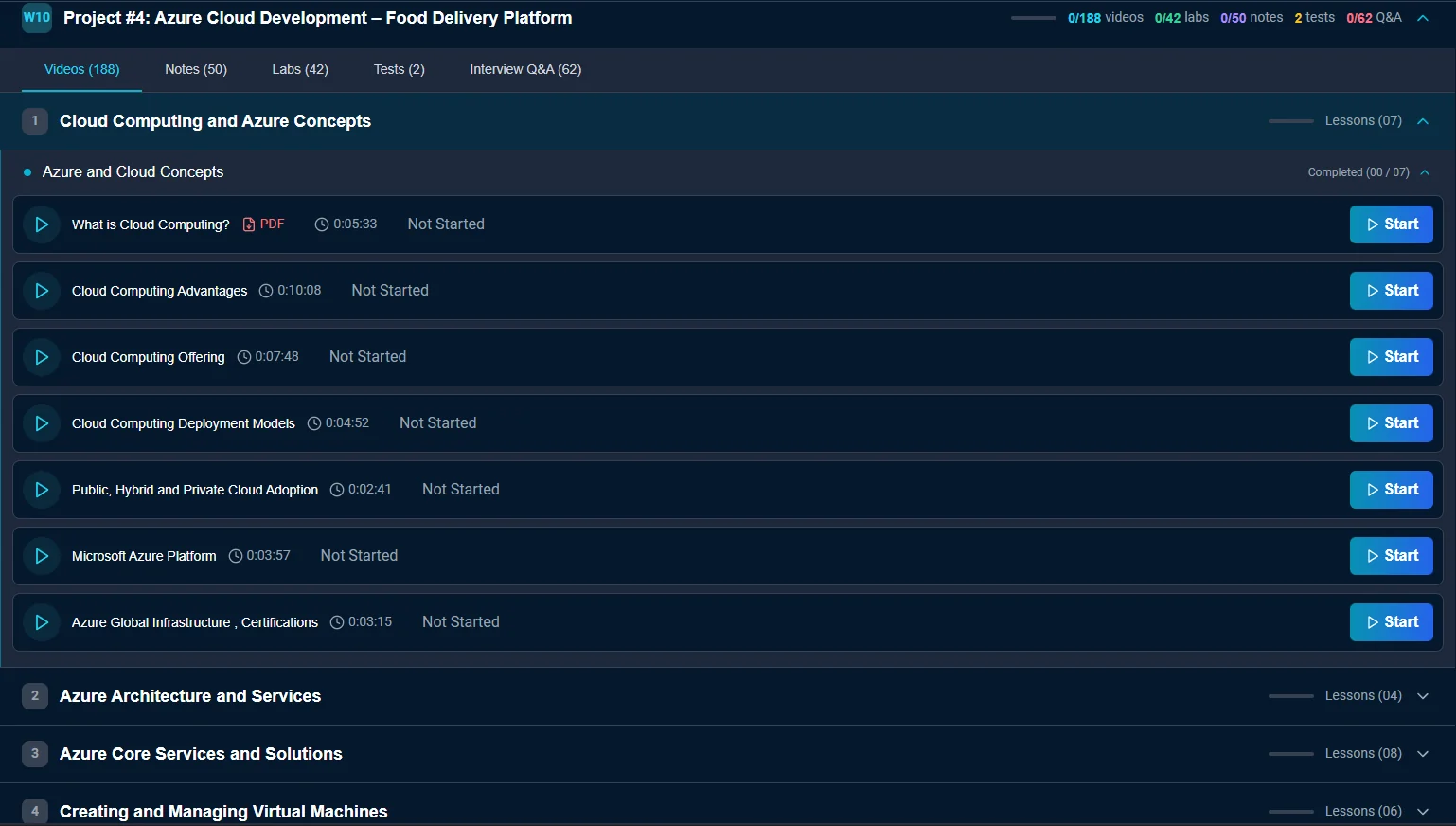
Food Delivery Platform
Azure Cloud Deployment
ASP.NET CoreAzureCI/CDKey Vault
Build and deploy a scalable food delivery platform using ASP.NET Core with Azure cloud services, CI/CD pipelines, secure secrets management using Azure Key Vault, and production-ready deployment.
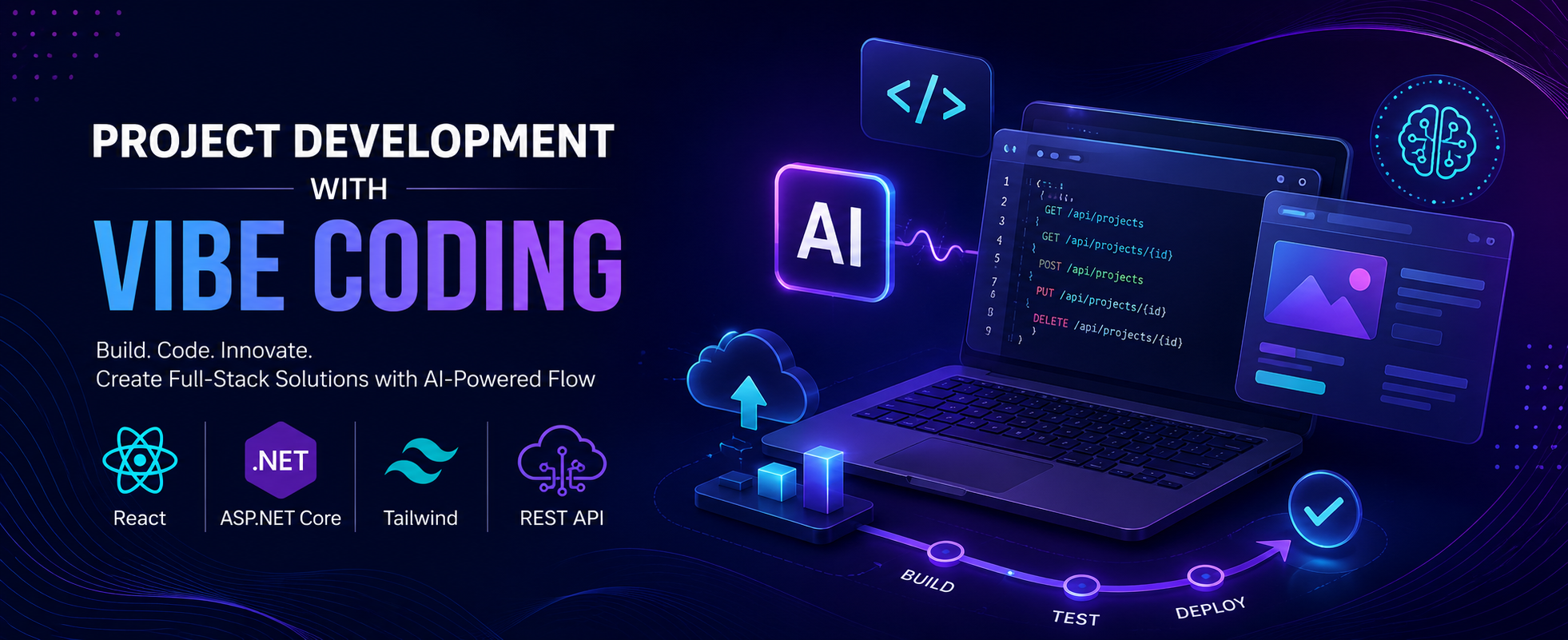
Project Development with Vibe Coding
AI-Powered Full-Stack Development
ReactASP.NET CoreTailwindREST API
Build modern full-stack applications using AI-powered vibe coding with React, ASP.NET Core, Tailwind CSS, and REST APIs to rapidly design, develop, and deploy production-ready solutions.
Tools and Technologies Covered
Everything you need to become an AI-Driven .NET Architect.
ASP.NET Core
Web API
RAG
Azure AKS
JWT
VS Code
GitHub
AI
ML.NET
ChatGPT
ASP.NET Core
Web API
RAG
Azure Monitor
Azure AKS
JWT
VS Code
GitHub
AI
ML.NET
ChatGPT
GitHub Copilot
Azure
Virtual Machine
Web App
Ocelot Gateway
RabbitMQ
Microservices
Docker
Kubernetes
Azure Pipelines
Cosmos DB
Key Vault
Architectural Patterns
Design Patterns
Interview Prep
GitHub Copilot
Azure
Virtual Machine
Web App
Ocelot Gateway
RabbitMQ
Microservices
Docker
Kubernetes
Azure Pipelines
Cosmos DB
Key Vault
Architectural Patterns
Design Patterns
Interview Prep
Complete Learning Roadmap
Curriculum — 15 Weeks Career Transformation Program
Introduction to Software Architecture
▶ Functional and Non-Functional Requirements
Watch this lesson instantly
0:26:05
▶ Preview
▶ Architecture Design
Watch this lesson instantly
0:03:54
▶ Preview
▶ Architecture Evaluation
Watch this lesson instantly
0:10:11
▶ Preview
▶ Architecture Documentation
Watch this lesson instantly
0:01:41
▶ Preview
▶ Architecture Implementation
Watch this lesson instantly
0:01:19
▶ Preview
Strategic Approaches
▶ Strategic Approach For Choosing Technology Stack
Watch this lesson instantly
0:04:24
▶ Preview
▶ Strategic Approach For Architecture Selection
Watch this lesson instantly
0:02:43
▶ Preview
▶ Strategic Approach For Architecture Selection Design Patterns
Watch this lesson instantly
0:01:48
▶ Preview
▶ Strategic Approach For Technology Selection
Watch this lesson instantly
0:03:33
▶ Preview
▶ Strategic Approach For Deployment
Watch this lesson instantly
0:01:05
▶ Preview
System Models & Networking
▶ Centralized, Decentralized and Distributed Systems
Watch this lesson instantly
0:03:39
▶ Preview
🔒
Distributed System Key Characteristics
0:00:49
🔒
Load Balancing
0:02:41
▶ Forward and Reverse Proxies
Watch this lesson instantly
0:01:28
▶ Preview
▶ Web Sockets and Long Pooling
Watch this lesson instantly
0:03:02
▶ Preview
🔒
Rate Limiting
0:01:49
Data Management & Storage
▶ Database Sharding
Watch this lesson instantly
0:00:33
▶ Preview
▶ Database Partitioning
Watch this lesson instantly
0:00:33
▶ Preview
▶ CAP Theorem (Consistency Availability Partition Theorem)
Watch this lesson instantly
0:01:43
▶ Preview
▶ Storage and cache
Watch this lesson instantly
0:01:53
▶ Preview
System Design & Architecture
▶ Scaling a System from Zero to Millions of Users
Watch this lesson instantly
0:09:53
▶ Preview
🔒
Drawing Architecture Diagrams with Draw.io
0:13:45
🔒
Designing a WhatsApp-Like Chat System
0:10:31
🔒
Instagram System Design & Capacity Estimation
0:08:58
🔒
Video Platform & E-commerce System Design Overview
0:04:08
.Net Software Architecture & Design
Background Job Processor (In-Memory)
00:30:00
Image CDN with Disk Cache in .NET
00:30:00
System Design With .Net & Azure
Load Balancer & Rate Limiting in C#
00:30:00
Threading vs Async-Await Simulation in C#
00:30:00
Caching with Redis and Memcached
00:30:00
API Versioning in ASP.NET Core Web API
00:30:00
Consistent Hashing Simulation in .NET
00:30:00
.Net Software Architecture & Design
Introduction to Software Architecture
15 Qs • 15 min
Strategic Approaches for Architecture and Technology Selection
15 Qs • 15 min
Strategic Approaches for Deployment and System Planning
15 Qs • 15 min
System Design With .Net & Azure
System Models & Networking
15 Qs • 15 min
Distributed Systems Core Concepts
15 Qs • 15 min
Scalable Data & Architecture
15 Qs • 15 min
System Design With .Net & Azure
System Models & Distributed System Fundamentals in .NET and Azure
0:02:30
Networking Essentials for Scalable Applications in .NET and Azure
0:02:00
Data Management and Storage Strategies in .NET and Azure
0:03:00
.Net Software Architecture & Design
Requirements in Software Architecture
0:03:00
System Design Concepts for .NET Architects
0:03:15
Architecture Evaluation
0:02:00
.Net Software Architecture & Design
Software Architecture Fundamentals
10 Qs • 0:25:00 min
Functional and Non-Functional Requirements
10 Qs • 0:18:00 min
Architecture Design and Evaluation
10 Qs • 0:21:00 min
Architecture Documentation and Implementation
10 Qs • 0:19:00 min
Software Architecture Styles
10 Qs • 0:23:00 min
Architectural Design Patterns
10 Qs • 0:20:00 min
Architecture Decision-Making and Trade-Offs
10 Qs • 0:17:00 min
Architecture Quality Attributes
10 Qs • 0:19:00 min
Deployment Architecture and Strategies
10 Qs • 0:15:00 min
System Design With .Net & Azure
Centralized, Decentralized, and Distributed Systems
10 Qs • 0:20:00 min
Distributed System Characteristics and Challenges
10 Qs • 0:16:00 min
Load Balancing and Traffic Distribution
10 Qs • 0:21:00 min
Forward and Reverse Proxies
10 Qs • 0:25:00 min
WebSockets and Long Polling
10 Qs • 0:19:00 min
Rate Limiting and Request Throttling
10 Qs • 0:20:00 min
Database Sharding and Partitioning
10 Qs • 0:17:00 min
CAP Theorem and Data Consistency
10 Qs • 0:19:00 min
Caching Strategies and Storage Architecture
10 Qs • 0:15:00 min
System Scalability and Capacity Estimation
10 Qs • 0:18:00 min
Architecture Diagrams and System Design Principles
10 Qs • 0:16:00 min
SOLID Principles
▶ Solid Principles
Watch this lesson instantly
0:01:29
▶ Preview
SOLID: Single Responsibility Principle
▶ Single Responsibility Principle (SRP)
Watch this lesson instantly
0:02:06
▶ Preview
🔒
Demo: Single Responsibility Principle(SRP)
0:09:42
SOLID: Open Closed Principle
🔒
Open Closed Principle (OCP)
0:03:23
🔒
DEMO: Open/Closed Principle
00:06:49
SOLID: Liskov Substitution Principle
🔒
Liskov Substitution Principle (LSP)
0:01:43
🔒
Demo: Liskov Substitution Principle (LSP)
00:09:45
SOLID: Interface Segregation Principle
🔒
Interface Segregation Principle (ISP)
0:02:37
🔒
Demo: Interface Segregation Principle (ISP)
0:08:38
SOLID: Dependency Inversion Principle
🔒
Dependency Inversion Principle (DIP)
00:04:00
🔒
Demo: Dependency Inversion Principle (DIP)
00:11:47
Introduction
▶ What is GOF?
Watch this lesson instantly
00:00:58
▶ Preview
🔒
GOF Design Patterns
00:01:20
🔒
Creational Design Patterns
00:01:03
Course Overview
🔒
Course Overview
00:01:41
Singleton Pattern
▶ Singleton Pattern
Watch this lesson instantly
00:01:31
▶ Preview
▶ Demo: Singleton Pattern
Watch this lesson instantly
00:08:36
▶ Preview
Prototype Pattern
🔒
Prototype Design Pattern
00:03:37
🔒
Demo: Prototype Pattern
00:13:45
Factory Method Pattern
🔒
Factory Method
00:06:18
🔒
Demo: Factory Method
00:09:41
Abstract Factory Pattern
🔒
Abstract factory
00:03:37
🔒
Demo: Abstract Factory
00:10:32
Builder Pattern
🔒
Builder Pattern
00:02:55
🔒
Demo: Builder Pattern
00:18:37
Course Overview
🔒
Course Overview
00:01:23
▶ Structural Patterns
Watch this lesson instantly
00:01:28
▶ Preview
Adapter Design pattern
▶ Adapter Design pattern
Watch this lesson instantly
00:04:02
▶ Preview
▶ Demo: Adapter Design pattern
Watch this lesson instantly
00:14:35
▶ Preview
Bridge Design pattern
🔒
Bridge Pattern
00:05:10
🔒
Demo: Bridge Pattern
00:07:31
Composite Design pattern
🔒
Composite Design Pattern
00:01:36
🔒
Demo: Composite Design Pattern
00:22:24
Facade Design pattern
🔒
Facade Design pattern
00:04:40
🔒
Demo: Facade Design pattern
00:15:02
Flyweight Design pattern
🔒
Introduction
00:05:00
🔒
Use Case
00:03:00
Proxy Design pattern
🔒
Proxy Design pattern
00:03:16
🔒
Demo: Proxy Design pattern
00:07:31
Decorator Design pattern
🔒
Decorator Design pattern
00:04:15
🔒
Demo: Decorator Design pattern
00:10:55
Course Overview
🔒
Course Overview
00:01:13
▶ Behavioural Design Patterns
Watch this lesson instantly
00:00:58
▶ Preview
Chain of Responsibility Design pattern
🔒
Chain of Responsibility Design pattern
00:02:01
🔒
Demo: Chain of Responsibility Design pattern
00:13:01
Command Design pattern
🔒
Command Design pattern
00:02:04
🔒
Demo : Command Design pattern
00:11:36
Interpreter Design Pattern
🔒
Interpreter Design Pattern
00:01:15
🔒
Demo: Interpreter Design Pattern
00:07:04
Iterator Design pattern
🔒
Iterator Design pattern
00:01:14
🔒
Demo: Iterator Design pattern
00:10:41
Mediator Design pattern
🔒
Mediator Design pattern
00:01:31
🔒
Demo: Mediator Design pattern
00:10:53
Memento Design pattern
🔒
Memento Design pattern
00:01:24
🔒
Demo: Memento Design pattern
00:10:40
Observer Design pattern
🔒
Introduction
00:04:14
🔒
Use Case
00:01:12
State Design pattern
🔒
State Design pattern
00:01:51
🔒
Demo: State Design pattern
00:26:04
Strategy Design pattern
🔒
Strategy Design pattern
00:02:37
🔒
Demo: Strategy Design pattern
00:07:47
Template Method Design pattern
🔒
Template Method Design pattern
00:02:05
🔒
Demo : Template Method Design pattern
00:03:56
Visitor Design pattern
🔒
Visitor Design pattern
00:02:17
🔒
Demo : Visitor Design pattern
00:09:28
SOLID : Software Design Principles
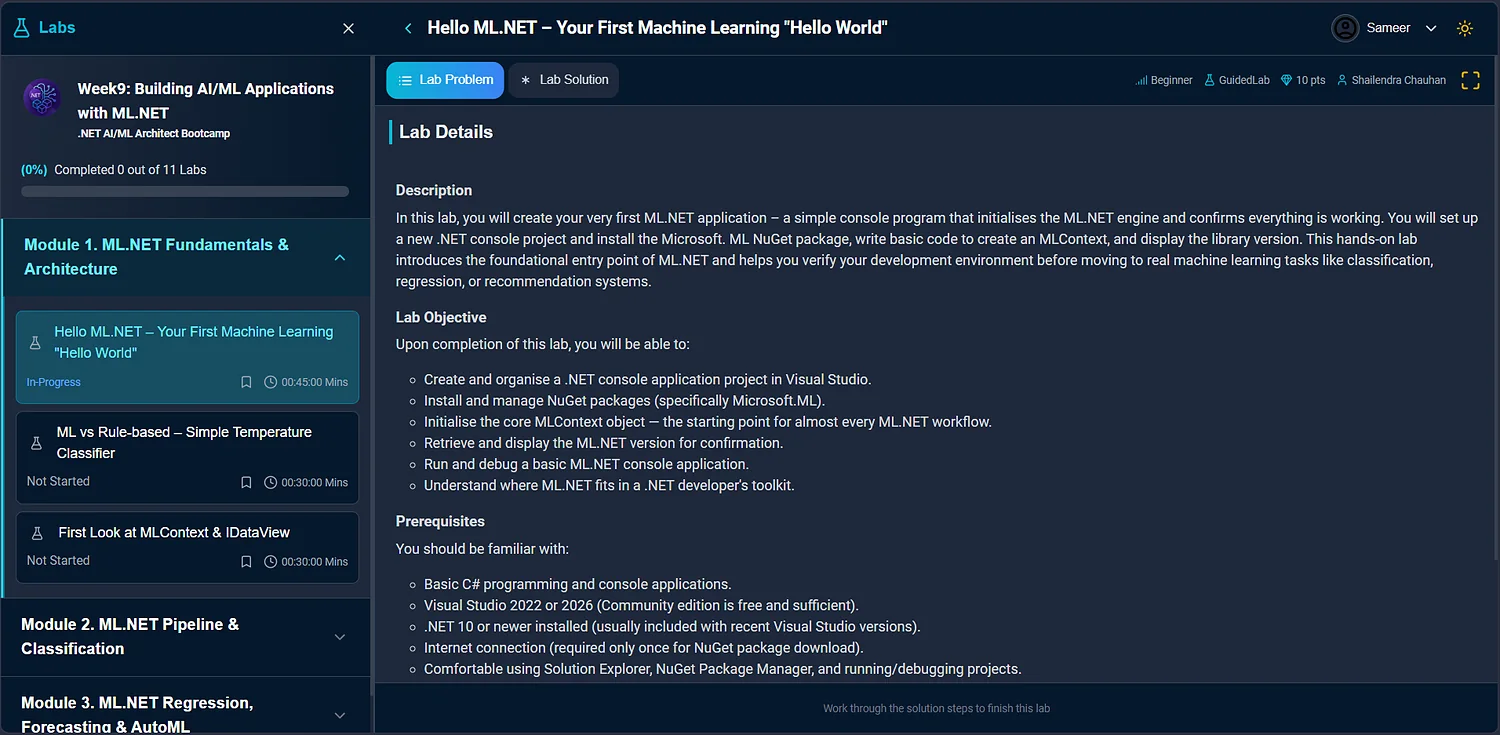
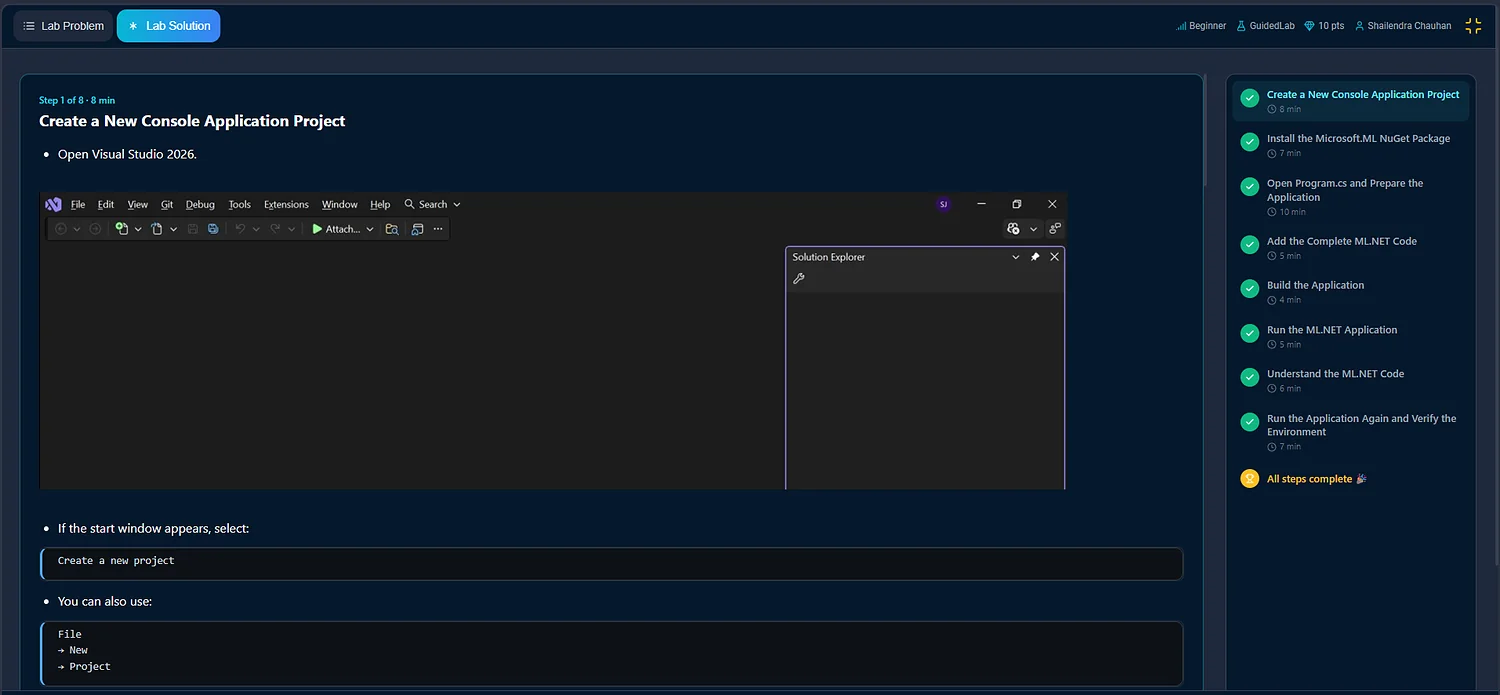
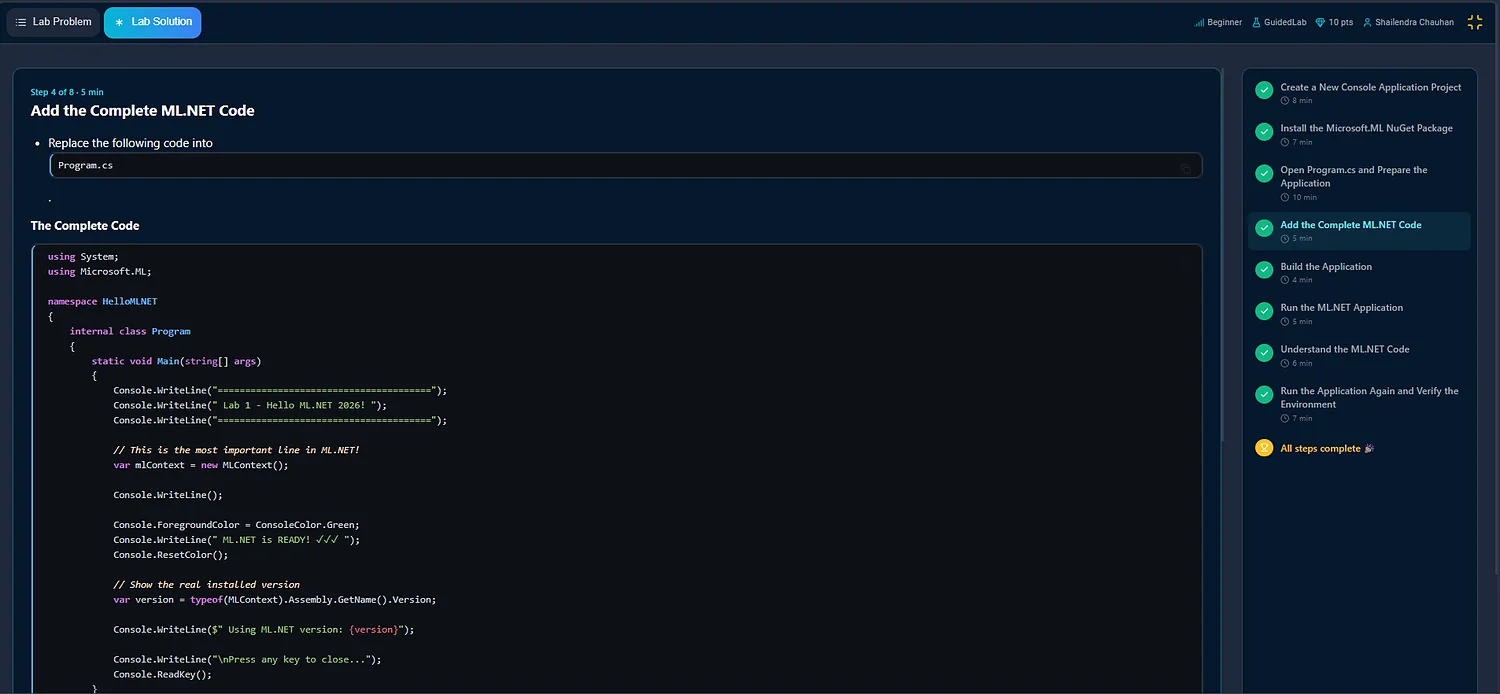
Single Responsibility Principle (SRP) – Guided Hands-On Lab
A job-focused bootcamp with mentorship, projects, AI learning & career support.
Feature Comparison 10 key differentiators
ScholarHat Bootcamp
Career Transformation Program
Other Platforms
Generic self-paced courses
Learning Style
Hybrid Learning Self-paced + weekly live doubt sessions
Self-Paced Learning Only
Mentors & Trainers
Microsoft MVPs Learn from .NET Solution Architects
Freelancers, Trainers, Teachers
Learning Approach
LEAD-ACE Driven Career transformation focused
Technology-Centric Only
Technology Coverage
Industry-Focused Modern & current tech stack
Limited or Outdated Coverage
Real-World Projects
4–5 Industry Projects Production-grade applications
1–2 Basic POC or Demo Projects
Labs & Notes
490+ Resources 330+ labs · 160+ notes
Very Limited Practice Resources
Resume, GitHub & LinkedIn
Included
Not Included
Professional Growth Skills
Included Communication · Leadership · Conflict Mgmt
Not Included
Skill Tests & Cert Prep
Included Microsoft certification preparation
Not Included
Mentor Guidance & Mock Interviews
Included
Not Included
Learners who made the switch
4.7 Average Reviews
01
I have taken class from Scholarhat it exceptionally changed my mind set and approach about development I can say that after getting training from Scholarhat I’m very much confident about my work whatever I’m doing because now I’m knowing what, where and how to implement things in my project, thanks Scholarhat for giving me in depth skills.
Parmanand KumarSoftware Engineer
02
I have gone through Scholarhat blogs many times for learning AngularJS from that time, I was waiting for AngularJS training batch. I was confused before the training because I wanted to get training on real time project which they have delivered according to my expectation now I’m so much confident about AngularJS development.
vibhu mishraSoftware Programmer
03
Scholarhat is a good training institute for learning real time projects. Our knowledge today does not have much value beyond a couple of years. Your value is what you can learn and how easily you can adapt to the changes this profession brings so often. Mr. Shailendra always teaches latest technologies. So, I found its worth to learn in Scholarhat and coding actually becomes rhyme.
Manju Lata YadavSoftware Professional
04
Scholarhat is a good training company for real time Software Development. I have taken training over MVC Development with AgularJs. Mr. Shailendra Sir always teaches latest technologies. So, I found its worth to learn in Scholarhat and coding actually becomes rhyme.
Ajeet SinghSoftware Developer
05
I am Pushpendra Singh, Managing Director of Techsan India Technologies Pvt. Ltd. I am truly impressed with the quality of development training delivered by ScholarHat and their continued commitment to building strong and creative career paths for students. I highly recommend ScholarHat for Java and Spring Boot training. He is highly skilled, intuitive, dedicated, and genuinely cares about his students’ growth. His training approach is always aligned with the latest technologies and real-world industry requirements.
Q1. What is the .NET AI/ML Solution Architect Bootcamp?
The .NET AI/ML Solution Architect Bootcamp is an intensive career-focused program designed for software developers who want to become AI-enabled Solution Architects. The bootcamp teaches AI/ML fundamentals, Generative AI, ML.NET, Azure AI services, system design, cloud architecture, and enterprise application development using the Microsoft technology stack.
Q2. Why should .NET solution architect learn AI and Machine Learning in 2026?
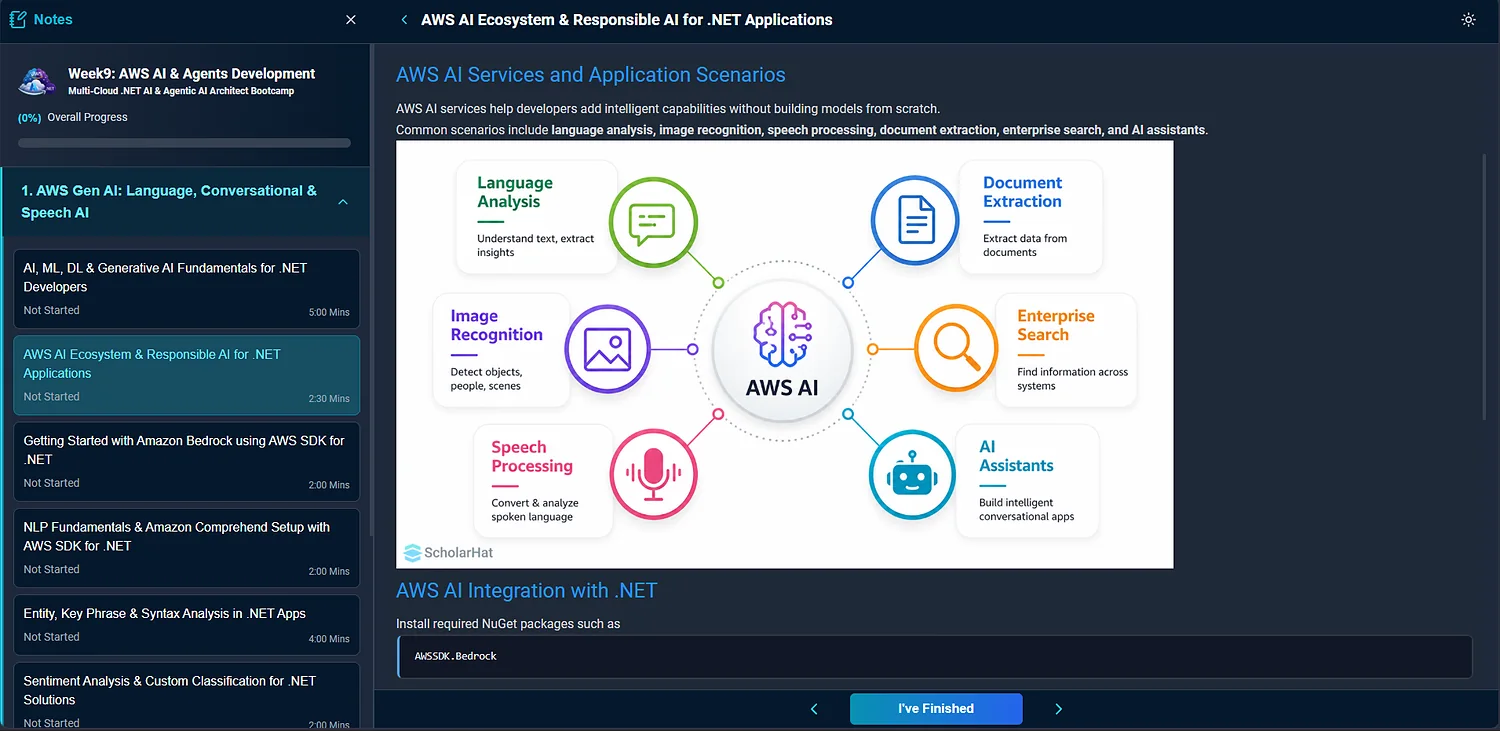
AI is becoming a core component of modern software systems. Organizations are increasingly integrating intelligent features such as chatbots, recommendation engines, document intelligence, predictive analytics, and AI agents into business applications. Learning AI helps .NET architect remain competitive and future-ready in the evolving software industry.
Q3. What will developers learn in the .NET AI/ML Solution Architect Bootcamp?
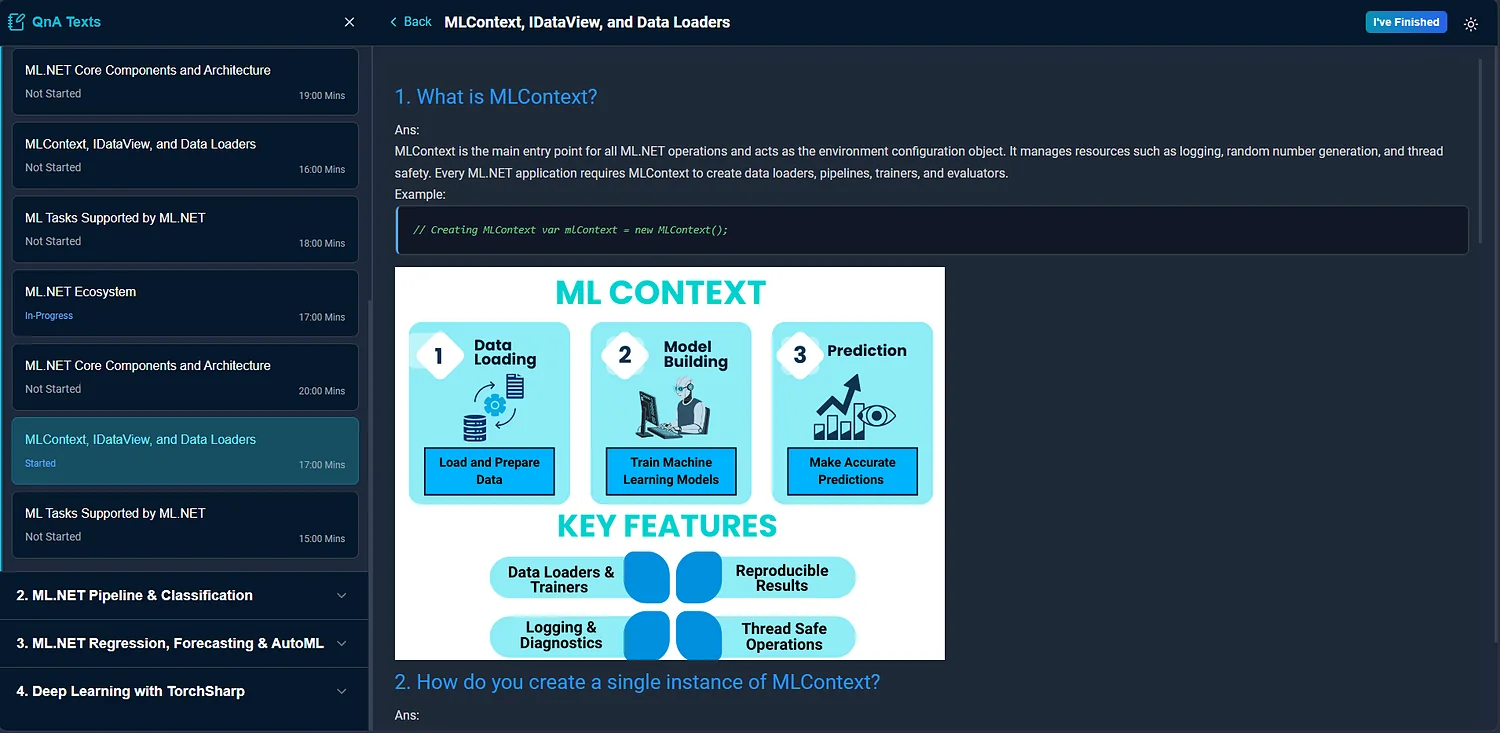
Developers learn AI development, Machine Learning concepts, ML.NET, Azure AI services, Azure OpenAI, Generative AI, Prompt Engineering, RAG architecture, Vector Databases, ASP.NET Core integration, cloud deployment, system design, and enterprise architecture practices. The program emphasizes practical implementation through real-world projects.
Q4. Which AI and cloud technologies are covered in this bootcamp?
The bootcamp covers ML.NET, Azure AI Services, Azure OpenAI, Azure AI Search, Azure AI Foundry, OpenAI APIs, LangChain, Semantic Kernel, Vector Databases, Prompt Engineering, AI Agents, ASP.NET Core, Azure Cloud, Docker, GitHub Copilot, and modern AI application development tools.
Q5. Why is ML.NET important for .NET architect?
ML.NET enables developers to build, train, and deploy machine learning models directly within the .NET ecosystem using C#. It allows organizations to add intelligent features without switching to another programming language. The bootcamp includes practical implementation of ML.NET in real-world applications.
Q6. What is Azure OpenAI Service and why is it important?
Azure OpenAI provides enterprise access to advanced AI models including GPT-based large language models through Microsoft's secure cloud platform. Organizations use Azure OpenAI to build chatbots, copilots, document processing solutions, knowledge assistants, and AI-powered business applications.
Q7. What is Retrieval-Augmented Generation (RAG)?
RAG is an AI architecture pattern that combines large language models with external knowledge sources such as company documents, databases, and enterprise content. It helps AI systems generate accurate and context-aware responses while reducing hallucinations. Developers learn practical RAG implementation using Azure AI Search and vector databases.
Q8. What is Prompt Engineering and why is it a critical skill?
Prompt Engineering is the practice of designing effective instructions that guide AI models to generate high-quality outputs. Proper prompting improves accuracy, consistency, reasoning, and business outcomes. The bootcamp teaches advanced prompting techniques used in enterprise AI applications.
Q9. What role do Vector Databases play in AI applications?
Vector databases store embeddings generated from documents, images, and other content. They enable semantic search and contextual retrieval for AI applications. Modern AI assistants, enterprise search platforms, and RAG systems depend heavily on vector search capabilities.
Q10. How does AI integrate with ASP.NET Core applications?
ASP.NET Core applications can integrate AI services through APIs, SDKs, AI agents, and machine learning models. Developers can build intelligent web applications that support natural language interaction, recommendations, content generation, document processing, and predictive analytics.
Q11. Are AI and Machine Learning skills in high demand?
Yes. Organizations across healthcare, finance, retail, manufacturing, SaaS, and consulting industries are actively hiring professionals with AI, Machine Learning, Generative AI, and cloud architecture expertise. AI-enabled development has become one of the fastest-growing areas in software engineering.
Q12. What career opportunities are available after completing this bootcamp?
Graduates can pursue roles such as AI Solution Architect, AI Application Developer, AI Engineer, Machine Learning Engineer, GenAI Engineer, Azure AI Developer, Technical Architect, Cloud Architect, and AI Platform Engineer. These roles are increasingly sought after across enterprise technology organizations.
Q13. How is an AI Architect different from a traditional Software Architect?
A traditional Software Architect focuses primarily on system design, scalability, performance, and software architecture. An AI Architect combines these skills with AI model integration, machine learning workflows, data pipelines, AI governance, vector search, and intelligent application design.
Q14. Does the bootcamp cover real-world AI project development?
Yes. Participants build practical AI-powered applications including intelligent chatbots, enterprise knowledge assistants, document processing solutions, recommendation systems, AI copilots, and cloud-hosted AI services. The focus is on production-ready implementation rather than theoretical concepts.
Q15. Will developers learn system design and architecture along with AI?
Yes. The program combines AI development with architectural thinking. Participants learn scalable system design, Clean Architecture, cloud-native design principles, API design, microservices integration, performance optimization, security, and AI solution architecture best practices.
Q16. Is Azure AI knowledge mandatory for modern enterprise developers?
Cloud AI platforms have become the preferred way for organizations to build and deploy AI solutions. Understanding Azure AI services, Azure OpenAI, AI Search, and cloud deployment significantly improves a developer’s ability to build enterprise-grade AI applications.
Q17. Can experienced .NET developers transition into AI Architect roles through this bootcamp?
Yes. The bootcamp is specifically designed to help .NET developers move toward AI-focused technical leadership and architecture roles. It provides a structured pathway from traditional application development to AI-enabled solution architecture.
Q18. What makes ScholarHat's .NET AI/ML Solution Architect Bootcamp different from other AI courses?
Unlike theory-heavy AI courses, this bootcamp combines AI, software architecture, cloud engineering, system design, and real-world implementation using the Microsoft ecosystem. Participants learn how to design, build, deploy, and scale enterprise-grade AI solutions while preparing for senior engineering and architecture roles.
Q19. Does the program include hands-on labs and enterprise use cases?
Yes. The curriculum includes hands-on coding exercises, AI implementation labs, architecture design challenges, cloud deployment scenarios, case studies, and real-world enterprise projects. Practical learning is a core component of the bootcamp experience.
Q20. Is becoming an AI Architect a future-proof career path?
Yes. As organizations increasingly adopt AI-powered products, intelligent automation, AI agents, and Generative AI solutions, the demand for professionals who can architect and govern enterprise AI systems continues to grow. AI Architecture is expected to remain one of the most valuable technology career paths throughout the coming decade.




 ASP.NET Core
 Web API
 RAG
 Azure AKS
 JWT
 VS Code
 GitHub
 AI
 ML.NET
 ChatGPT
 Azure Monitor
 GitHub Copilot
 Azure
 Virtual Machine
 Web App
 Ocelot Gateway
 RabbitMQ
 Microservices
 Docker
 Kubernetes
 Azure Pipelines
 Cosmos DB
 Key Vault
 Architectural Patterns
 Design Patterns
 Interview Prep