
Artificial Intelligence is quickly shifting from basic chatbots and predictive models to systems that can act on goals, make decisions, and complete tasks on their own. This new evolution is called Agentic AI which focuses on building AI agents that can plan, reason, use tools, and execute multi-step workflows without constant human help.
In this Artificial Intelligence tutorial, you’ll learn the Complete Agentic AI Engineer Roadmap, explained in simple, clear steps. We’ll walk through the skills you need, from basic Python and LLM fundamentals to advanced concepts like tool use, memory, LangGraph, cloud deployment, and so on.
What is Agentic AI?
Agentic AI refers to systems that can understand goals, break them into tasks, use tools, gather information, and act autonomously. These systems don’t just “respond”—they take initiative, solve problems, and complete workflows by reasoning step-by-step and integrating with external tools, APIs, and data sources.
Key Characteristics:
- Goal-driven reasoning: Understands objectives and breaks them into smaller actionable steps.
- Tool and API integration: Uses external tools, databases, and APIs to gather information and take action.
- Autonomous task execution: Completes workflows end-to-end instead of generating isolated responses.
- Adaptive decision-making: Adjusts actions based on context, feedback, and real-time data
What Does an Agentic AI Engineer Do?
An Agentic AI Engineer builds autonomous AI agents that can reason, plan, use tools, access systems, and complete actions across cloud and enterprise environments.
Core Responsibilities:
- Design reasoning & planning frameworks: Implements ReAct, planning, memory, and decision logic for agents.
- Integrate tools and systems: Connects agents to APIs, databases, cloud services, web apps, and internal business systems.
- Develop memory & guardrails: Builds long-term memory, safety layers, permissions, and enterprise controls.
- Deploy to production: Launches agents using Azure, AWS, LangGraph, or custom orchestrators with monitoring and observability.
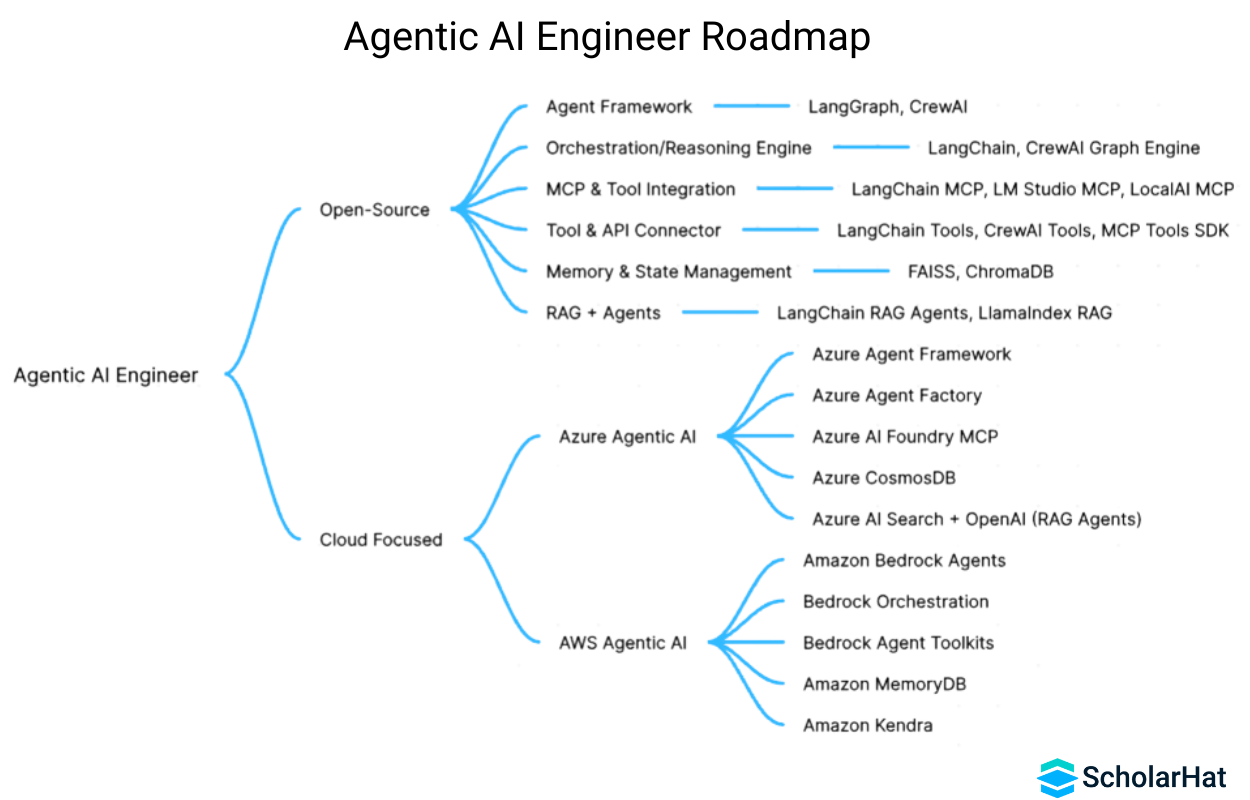
The Complete Agentic AI Roadmap: Step-by-Step Guide
It is structured into clear phases and stepwise progressions so learners can follow a practical, industry-focused path toward mastering autonomous AI systems.
- Phase 1: Open-Source Agentic AI Stack: Understand and engineer how agents think and operate
- Phase 2: Cloud-Focused Agentic AI Stack (Azure & AWS): Deploy, govern, and scale agents for real-world production
- Mastering both transforms you from a developer into an AI systems architect.
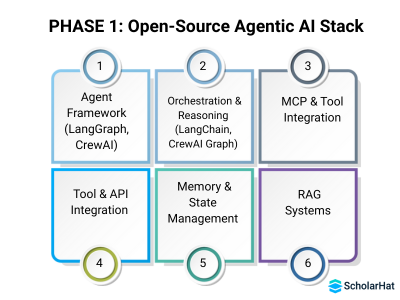
PHASE 1: Open-Source Agentic AI Stack
This phase teaches you how Agentic AI systems think, plan, and act using open-source tools.You learn how to build autonomous agents with memory, tools, and reasoning skills.This phase focuses on logic and architecture before moving to cloud deployment.
Step 1: Agent Framework (LangGraph, CrewAI)
Agent frameworks form the structure of autonomous systems. They define how an agent enters a task, how decisions are made, how tasks are distributed, and how outcomes are achieved.In this phase, you don’t just build agents, you design intelligence systems.
What you learn in depth:
- How to design decision-making agents that break down large tasks into manageable steps.
- How to configure multi-agent ecosystems where different agents specialize in research, planning, validation, and execution.
- How to assign agent personas and skill roles to simulate team-like collaboration.
- How to build state-driven execution paths where agents react dynamically to outcomes.
- How agents share context and coordinate actions to avoid duplication or conflict.
- How to detect failures and reroute decisions automatically without human intervention.
Without a framework, you write scripts.With a framework, you build intelligent machines that operate independently.
Step 2: Orchestration & Reasoning Engine (LangChain, CrewAI Graph Engine)
If agent frameworks define who does what, orchestration defines how work flows.
This phase teaches you how to control logic and behavior at scale.
You will master:
- Building reasoning chains for complex decision-making.
- Creating fallback systems that recover when a process fails.
- Designing intelligent loops that validate results before final execution.
- Controlling dependencies between agents and tools.
- Managing conditional logic that mirrors real business workflows.
Step 3: MCP & Tool Integration (LangChain MCP, LM Studio MCP, LocalAI MCP)
MCP (Model Context Protocol) is the foundation of model independence.
This phase shifts you from:
"Using an AI model" to "Building a model-agnostic system"
What you learn:
- How to swap AI models without changing your agent logic.
- How to manage model context efficiently.
- How to integrate local and cloud models seamlessly.
- How tool behavior is standardized across systems.
- How agents choose which model to use for which task.
- How performance is optimized through protocol-based design.
Step 4: Tool & API Connector (LangChain Tools, CrewAI Tools, MCP Tool SDK)
This is where agents become operational in the real world.
In this stage, agents gain “hands and feet”.
You will master:
- Automated interaction withAPIs,SaaS platforms,Databases,Websites,DevOps tools
- How agents send emails, update dashboards, generate reports, extract files, and automate workflows.
- How event-driven systems trigger AI workflows.
- How business processes are executed end-to-end without human assistance.
- How to design secure tool interfaces to prevent misuse.
Step 5: Memory & State Management (FAISS, ChromaDB)
Memory transforms an agent from smart to reliable.This phase builds long-term intelligence.
You will learn:
- How embeddings store meaning rather than keywords.
- How agents retrieve relevant data based on context rather than syntax.
- How conversation history improves decisions.
- How task history prevents duplication.
- How memory creates continuity across sessions.
- How external databases store enterprise knowledge.
Step 6: RAG + Agents (LangChain RAG Agents, LlamaIndex RAG)
RAG is what makes AI accurate, safe, and enterprise-ready.
In this phase, you learn:
- How documents become searchable intelligence.
- How agents reason using PDFs, emails, code, and databases.
- How hallucinations are reduced.
- How agents cite and validate sources.
- How enterprises build internal search engines powered by AI.
- How knowledge systems scale across organizations.
PHASE 2: Cloud-Focused Agentic AI Stack
After mastering open-source frameworks, Phase 2 focuses on operationalizing Agentic AI at enterprise scale. This phase teaches you how to deploy agents in environments that demand reliability, compliance, security, and performance at global scale. You move from building agents locally to managing thousands of AI agents across distributed cloud systems.
Azure Agentic AI Track
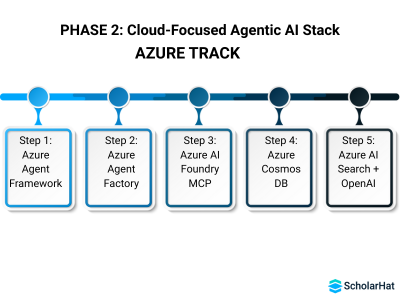
Step 1: Azure Agent Framework
This framework acts as the enterprise execution engine for AI agents, providing centralized control, security enforcement, and operational monitoring. It ensures agents operate safely within business rules while remaining scalable across teams and infrastructures.
You will learn:
- Implement enterprise-grade identity access controls for AI agents
- Monitor agent performance using real-time operational telemetry dashboards
- Apply governance policies across agents and tool executions
- Manage lifecycle of agents from deployment to retirement
- Configure secure communication channels between distributed AI systems
- Automate incident detection and recovery for agent workflows
Step 2: Azure Agent Factory
This component introduces the factory model for AI development, allowing teams to mass-produce, standardize, and deploy agents using automation-driven pipelines.
You will learn:
- Create standard agent templates for enterprise-wide development reuse
- Automate building, testing, and releasing AI agent systems
- Implement pipeline-driven deployment strategies for distributed AI workflows
- Enforce versioning and rollback strategies across agent infrastructure
- Establish continuous integration practices for dynamic AI systems
- Maintain production stability through controlled release mechanisms automation
Step 3: Azure AI Foundry MCP
Azure AI Foundry operates as the command center for enterprise Agentic AI, managing orchestration, policies, model governance, and runtime visibility.
You will learn:
- Manage centralized orchestration for multiple AI agent environments
- Enforce security policies across models, tools, and data
- Control tool permissions and agent execution privileges centrally
- Monitor model usage, latency, and resource efficiency continuously
- Implement traceability and audit logs for compliance readiness
- Establish governance pipelines for safe and scalable AI systems
Step 4: Azure Cosmos DB
Cosmos DB powers long-term memory and persistent intelligence for cloud-based agents, supporting large-scale storage and rapid data access worldwide.
You will learn:
- Design globally distributed databases for persistent agent context
- Enable low-latency access to real-time agent memory stores
- Scale memory automatically based on agent workload intensity
- Ensure data consistency across multiple geographic deployment regions
- Secure memory systems with encryption and access policies
- Implement backup strategies for business-critical agent state recovery
Step 5: Azure AI Search + OpenAI (RAG Agents)
This layer transforms organizational data into searchable intelligence, enabling agents to retrieve accurate knowledge in real-time.
You will learn:
- Index enterprise documents for intelligent real-time AI retrieval
- Build secure retrieval systems integrated with organizational knowledge
- Combine natural language understanding with enterprise keyword search
- Improve factual accuracy through contextual content-based response generation
- Enable compliance-aware content filtering for sensitive business knowledge
- Design enterprise search experiences using AI-powered relevance ranking
AWS Agentic AI Track
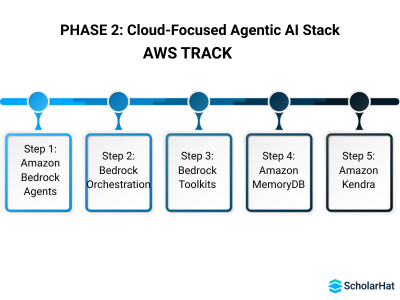
Step 1: Amazon Bedrock Agents
Bedrock provides managed infrastructure for enterprise-level AI deployment across multiple foundation models.
You will learn:
- Deploy multiple foundation models through unified Bedrock environments
- Route model requests using intelligent workload distribution logic
- Configure access control using fine-grained service policies across
- Monitor inference performance using built-in AWS model observability tools
- Secure enterprise integrations through encrypted service communication layers
- Optimize inference cost through usage-aware model routing strategies
Step 2: Bedrock Orchestration
This layer governs how agents reason, execute workflows, and coordinate tasks efficiently.
You will learn:
- Design multi-step reasoning pipelines for autonomous task execution
- Implement conditional workflow logic to control agent decision flows
- Enable event-driven triggers for real-time agent task initiation
- Coordinate data handoff between models and automation services
- Implement automatic recovery when task failures occur during execution
- Manage contextual input and output flows across agent lifecycles
Step 3: Bedrock Agent Toolkits
Toolkits allow engineers to extend agent capabilities with real business functions and integrations.
You will learn:
- Create reusable tools for enterprise-scale AI automation logic
- Integrate REST APIs securely into autonomous agent workflows
- Configure permission systems for safe and controlled tool usage
- Implement validation layers for tools used within agent execution
- Design extensible architectures supporting future integration growth easily
- Package automation logic as shareable enterprise-ready tool modules
Step 4: Amazon MemoryDB
MemoryDB enables ultra-fast storage and retrieval of agent state in mission-critical applications.
You will learn:
- Implement ultra-low latency memory access for active agents
- Design distributed memory architectures for mission-critical AI systems
- Enable fault tolerance through replication across availability zones
- Optimize read and write performance for frequent memory operations
- Configure automatic failover systems for continuous agent availability
- Support real-time state synchronization across distributed execution environments
Step 5: Amazon Kendra
Kendra provides secure, scalable enterprise search for Agentic AI systems.
You will learn:
- Ingest structured and unstructured data into enterprise indexes
- Configure semantic search for accurate business information discovery
- Enforce role-based document access across organizational AI systems
- Connect enterprise applications to unified AI-powered search experiences
- Maintain search freshness through automated data update pipelines
- Enable contextual knowledge delivery directly into agent reasoning systems
Career in Agentic AI
Agentic AI offers high-growth careers in engineering, automation, and cloud AI systems. Companies are hiring professionals who can build autonomous, reasoning-based AI agents. This field combines AI, software development, and cloud architecture skills.
1. Agentic AI Engineer
- This role focuses on designing and building autonomous AI agents that can plan tasks, reason through problems, and use tools without constant human guidance.
- They work with frameworks like LangChain, CrewAI, and LangGraph to create multi-agent systems.
2. AI Automation Specialist
- An AI Automation Specialist designs systems that replace or improve manual business processes using intelligent agents.
- They work closely with APIs, workflow tools, and AI integrations to automate operations like customer support, reporting, document processing, and scheduling.
3. LLM Workflow Engineer
- This role focuses on building structured logic around large language models.
- They design intelligent pipelines that manage prompts, reasoning loops, tool calls, and error handling.
4. Enterprise AI Architect
- An Enterprise AI Architect designs the full AI ecosystem for large organizations.
- They decide how agents are deployed, secured, monitored, and scaled across the company.
- They work with cloud platforms (Azure/AWS), databases, and security teams to build enterprise-grade AI infrastructures
5. AI Systems Designer
- AI Systems Designers create the blueprint for how AI components work together.
- They design how models, memory systems, tools, and APIs interact inside one platform.
- This role focuses more on architectural thinking and system planning than just coding.
6. Cloud AI Engineer
- A Cloud AI Engineer deploys and manages AI systems in cloud environments like Azure and AWS.
- They focus on scalability, security, Service uptime, and cost optimization.
- They convert AI projects into production-ready cloud solutions.
7. RAG & Memory System Developer
- This specialized role builds enterprise knowledge systems that combine retrieval with AI generation.
- They design vector databases, build document indexing pipelines, and make AI answers accurate using RAG techniques.
Career Boost: Get Certified
Certifications validate your skills and increase your credibility in enterprise AI roles—especially in agentic development and cloud deployment.
Recommended Certifications:
- Microsoft Certified: Azure AI Engineer Associate: best for agentic AI on Azure platforms.
- AWS Certified Machine Learning: Specialty excellent for Bedrock, SageMaker, and AWS agent pipelines.
Scholarhat Agentic AI Engineer Certification Course:
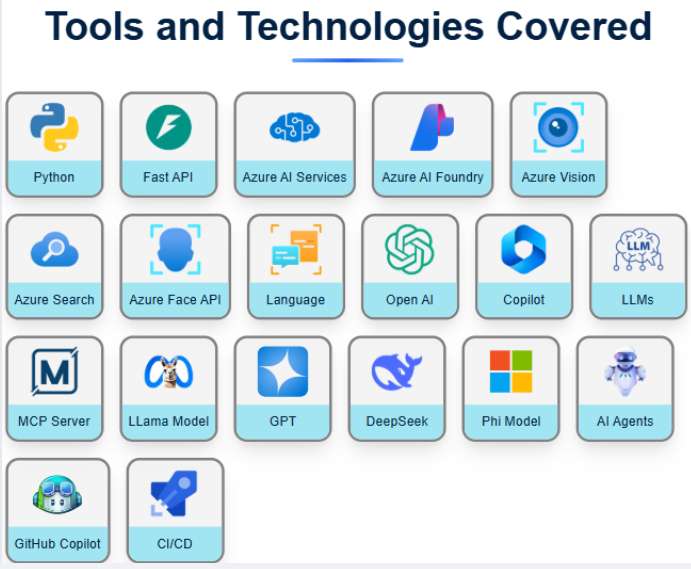
Features of this course are:
- A Proven Curriculum to get an AI Engineer Job of ₹32 LPA*
- 4 Months of Intensive Training
- Learn from Microsoft MVPs
- Build AI Apps & Agents with Azure Cloud
- Integrate GenAI/LLMs (GPT, DeepSeek)
- 4 Live projects shipped to Azure
- Become Microsoft Certified: Azure AI Engineer
- Practice tests to ace AI-102 + interview prep
- Unlimited Live Batch Access For 1 Yr
Conclusion
Agentic AI is transforming how modern systems think, reason, and execute real-world tasks. By following this roadmap, you’re already one step closer to building AI that doesn’t just respond but truly acts. The future belongs to engineers who can design autonomous, tool-using, workflow-driven AI agents.
Start your journey to becoming an Agentic AI Engineer today. Enrol now in Agentic AI Engineer Course. Learn the tools, frameworks, and skills needed to build production-ready AI agents.