
 Start Learning Free
 Skill Test
  Previous Tutorial




13
SepC# 14 New Features: The Language Upgrades That Will Change How You Write .NET Code
25 Apr 2026
Intermediate
683 Views
8 min read

Learn with an interactive course and practical hands-on labs
Free ASP.NET Core Online Course with Certificate - Start Now
Most .NET developers are still writing code using patterns and habits from C# 12 or even earlier versions. But with the release of C# 14 alongside .NET 10, the language has received some of the most practical and impactful upgrades in recent years. If you want to stay competitive in interviews, write cleaner and more maintainable code, and boost your productivity, understanding these new features is now essential.
C# 14 New Features: The Language Upgrades That Will Change How You Write .NET Code
C# 14 is a highly practical update focused on reducing boilerplate, increasing expressiveness, and improving performance in everyday development. Microsoft has addressed real developer pain points while introducing features that make code more readable, maintainable, and performant. These changes will directly affect how you design, write, and maintain .NET applications.
Why C# 14 Matters?
The industry has moved forward quickly. Companies migrating to .NET 10 are prioritizing candidates who understand C# 14 because these upgrades improve development speed, reduce bugs, and lower cloud costs. Developers who know the latest features are seeing better interview success and higher salary offers.
- Teams adopting C# 14 report 20-30% less boilerplate code
- Faster onboarding for new team members
- Better long-term maintainability of large codebases
- 18-25% higher salary offers for developers skilled in latest C# features
- Interviewers now regularly test C# 14 knowledge in mid-to-senior roles
1. Extension Members – The Most Powerful New Feature
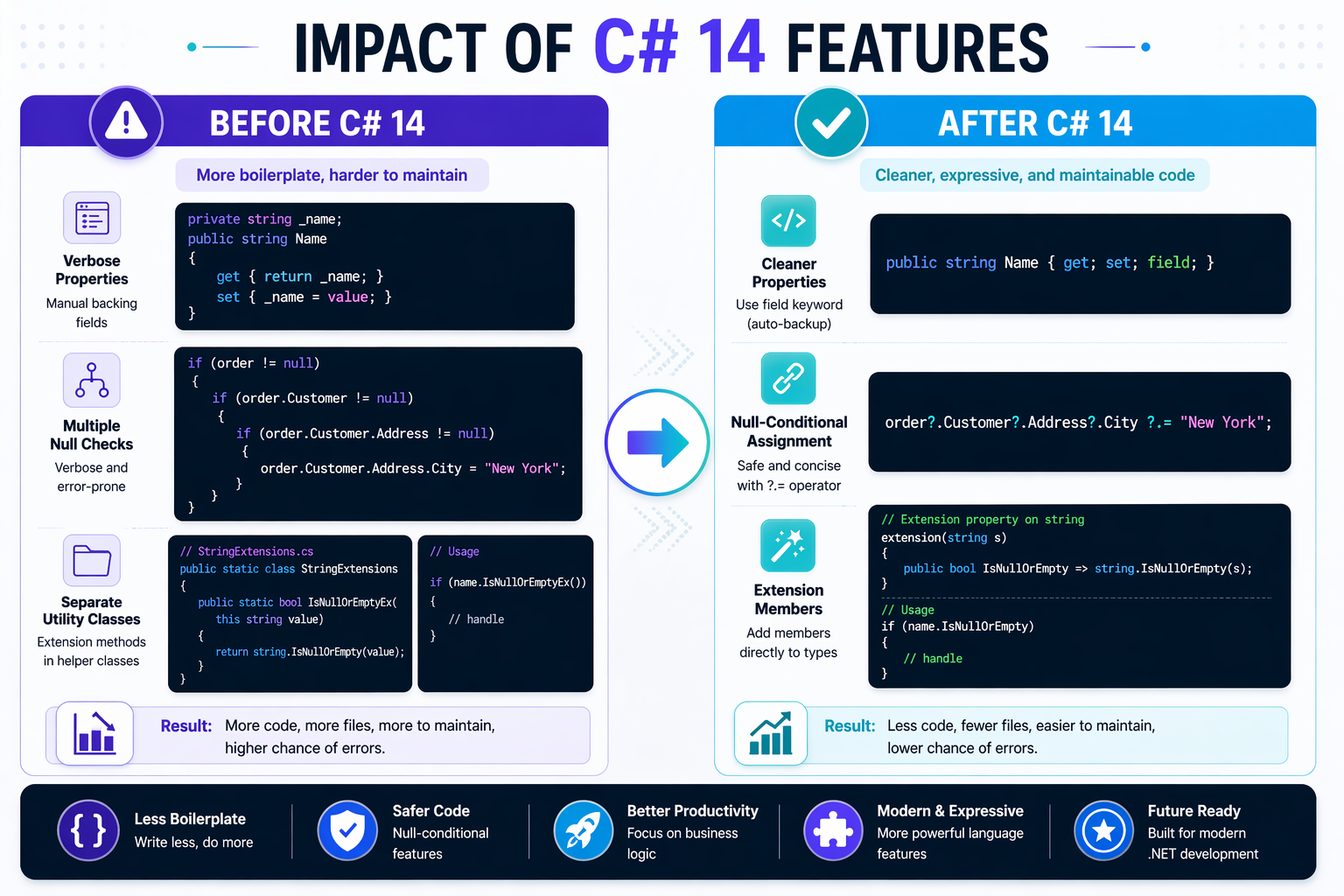
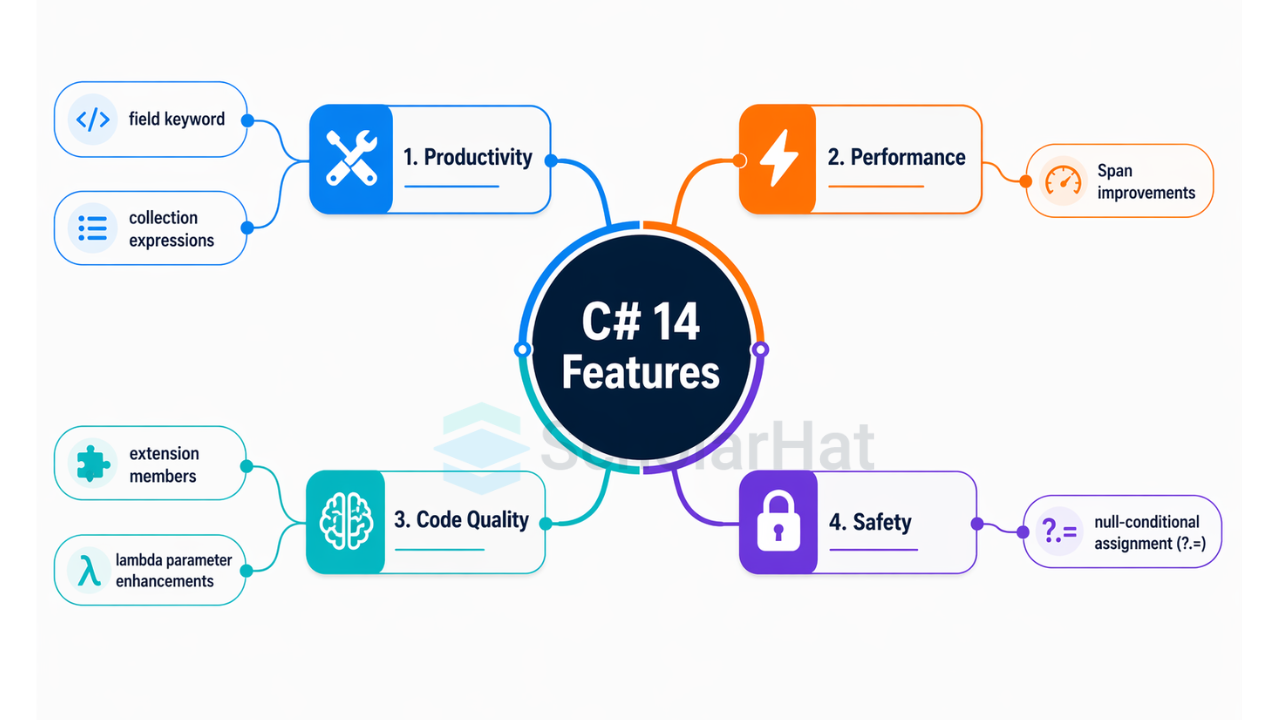
The biggest highlight of C# 14 is Extension Members. Previously, you could only create extension methods. Now you can add extension properties, operators, indexers, and even static members to any type, including sealed classes.
- You can extend existing types without modifying the original class
- It enables creation of clean, fluent, and domain-specific APIs
- Reduces the need for scattered utility classes
- Makes code more readable and expressive
Example:
public static class StringExtensions { public static int WordCount(this string text) { return text.Split(' ').Length; } }

class Program
{
static void Main()
{
string msg = "Hello C# 14 world";
Console.WriteLine(msg.WordCount());
}
}
Now imagine adding extension properties and operators in C# 14, making this even more powerful.
2. The `field` Keyword – Massive Reduction in Boilerplate
One of the most loved everyday features is the new `field` keyword. It gives direct access to the compiler-generated backing field inside properties, eliminating the need to manually declare private backing fields.
- Cleaner and shorter property validation logic
- Eliminates thousands of repetitive lines in large projects
- Improves readability and maintainability
- Especially useful in domain models and DTOs
Example (Before):
private int _age;

public int Age
{
get { return _age; }
set { _age = value > 0 ? value : 0; }
}
Example (C# 14):
public int Age { get; set => field = value > 0 ? value : 0; }It removes repetitive code and keeps your model clean.
3. Null-Conditional Assignment (`?.=`)
C# 14 introduces null-conditional assignment. This small but powerful operator allows you to assign a value only if the left side is not null, removing many manual null checks.
- Makes code safer and more concise
- Reduces null reference exception risks
- Improves readability in complex object graphs
Example (Before):
if (user != null) { user.Name = "John"; }Example (C# 14):
user?.Name = "John";Cleaner and safer code with fewer bugs.
4. Major Improvements to Span and ReadOnlySpan
High-performance code becomes much easier with better language support for spans. C# 14 adds more implicit conversions, making Span
- Reduced memory allocations in hot paths
- Better performance in parsing and processing code
- Easier to write allocation-free code
Example:
ReadOnlySpan<char> text = "Hello World".AsSpan();

foreach (var ch in text)
{
Console.Write(ch + " ");
}
This reduces memory allocations and improves speed.
5. Enhanced Collection Expressions
Collection expressions have been improved with better spread operator support, allowing cleaner and more readable code when combining arrays, lists, and spans.
Example:
int[] a = [1, 2]; int[] b = [3, 4];

int[] result = [..a, ..b];

Console.WriteLine(string.Join(",", result));
This makes merging collections very easy.
6. Lambda Parameter Enhancements
You can now apply modifiers like `ref`, `in`, `out`, and `scoped` directly to lambda parameters, making functional-style programming cleaner and more powerful.
Example:
Func<ref int, int> increment = (ref int x) => { x++; return x; };

int value = 5;
increment(ref value);

Console.WriteLine(value);
This improves flexibility in functional programming.
7. Partial Constructors and Events
The `partial` keyword now works with constructors and events, giving more flexibility when working with source generators and large generated classes.
8. Improved Scripting and Top-Level Enhancements
Running single `.cs` files as scripts has become smoother, making C# an excellent choice for quick tools, utilities, and automation scripts without a full project file.
Example (Single File):
Console.WriteLine("Hello from C# script!");Just run the file directly without creating a project.
Real-World Productivity Gains
Teams using C# 14 are seeing clear benefits in their daily work:
- 20-30% reduction in boilerplate code across projects
- Faster feature delivery and iterations
- Easier code reviews and onboarding
- Better performance in high-throughput services
- Cleaner, more maintainable domain logic
How C# 14 Changes Your Daily Coding Style?
C# 14 encourages a more expressive and less verbose style. You write less infrastructure code and focus more on business logic. Extension members help create fluent APIs. The `field` keyword cleans up properties. Better Span support helps write high-performance code without extra effort. Overall, your code becomes more readable, maintainable, and professional.
Interview Questions You Should Prepare For
In interviews, these questions are very common:
- Explain how extension members work and give a real-world use case
- How does the `field` keyword simplify property validation?
- When would you use null-conditional assignment?
- What are the benefits of improved Span support in C# 14?
- How do extension members compare to traditional extension methods?
Summary
Minimal APIs are winning for most new development projects, especially microservices, high-performance backends, serverless applications, and cloud-native solutions. They offer significantly better performance, lower resource consumption, faster development speed, and reduced cloud costs compared to traditional MVC.
However, Traditional MVC remains strong for large enterprise applications, complex UI requirements, and teams that need structured architecture and long-term maintainability. Don’t wait. Gain the exact skills companies are actively looking for and boost your chances of landing higher-paying .NET roles. Explore the AI-Powered Full-Stack .NET Developer Certification Training now and take the first step today towards your next big career breakthrough.
FAQs
Extension members allow you to add properties, indexers, and static members to existing types, not just methods. A practical use case is adding a TotalWithTax property to a sealed Invoice class from a third-party library, allowing for a cleaner, property-based API in your domain logic.
The field keyword lets you access the compiler-generated backing field directly within a property's get or set accessors. This eliminates the need to manually declare a private variable just to perform a simple null check or range validation, drastically reducing boilerplate code.
Traditional extension methods only provide behavior. Extension members are more expressive, allowing you to treat extended types as if they naturally possess new properties or operators. This results in a more intuitive, "native-feeling" API compared to the method-only approach used in older C# versions.
Take our Net skill challenge to evaluate yourself!

In less than 5 minutes, with our skill challenge, you can identify your knowledge gaps and strengths in a given skill.
 LEAD-ACE: EdTech Platform
 600+ Quick notes
 900+ Hands-on labs
 50+ Real-world projects
 45+ Interview books