
 Start Learning Free
 Skill Test
  Previous Tutorial






16
Oct.NET 10: What Every .NET Developer Must Know Before Their Next Job Interview
17 Apr 2026
Career
836 Views
8 min read

Learn with an interactive course and practical hands-on labs
Free ASP.NET Core Online Course with Certificate - Start Now
Most .NET developers are still comfortable with .NET 6 or .NET 8 patterns, but in 2026 interviewers are directly asking about .NET 10. If you freeze when someone mentions .NET 10 features, C# 14, .NET Aspire, Native AOT, or performance improvements, this comprehensive guide is for you. Here’s exactly what every .NET developer must know before their next job interview to stand out confidently and increase their chances of landing better offers.
.NET 10: What Every .NET Developer Must Know Before Their Next Job Interview
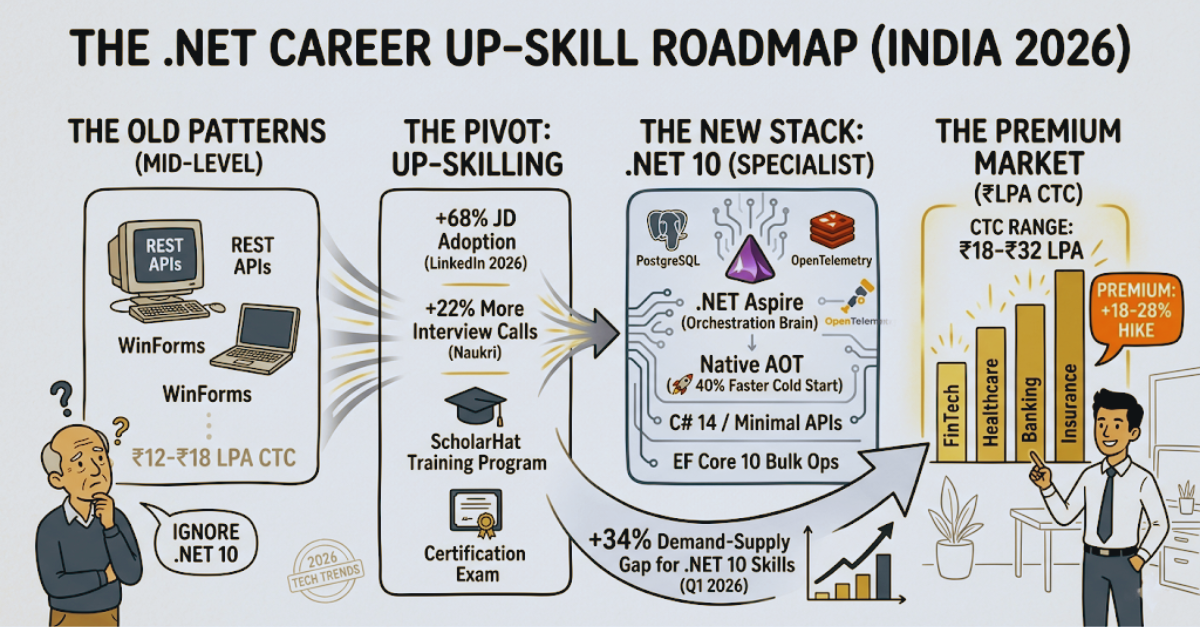
In 2026, .NET 10 has firmly become the new baseline for mid-to-senior .NET roles. According to LinkedIn’s Emerging Jobs Report Q1 2026 and Naukri.com hiring trends, more than 68% of .NET job descriptions now mention .NET 8 or .NET 10 as required or preferred. Companies are actively migrating legacy applications and building new systems on .NET 10 because it delivers measurable improvements in performance, cost efficiency, developer productivity, and cloud-native capabilities. Ignoring .NET 10 is no longer an option — it can cost you not just the job offer but also a significant salary difference of 18-28%.
Why .NET 10 Has Become So Important in the 2026 Job Market?
The industry shift towards .NET 10 is happening faster than many developers expected. Motion Recruitment’s 2026 Salary Guide and Stack Overflow Developer Survey 2025 clearly show that developers skilled in the latest .NET version receive 18-28% higher offers compared to those working on older versions. Companies are paying this premium because .NET 10 directly reduces cloud costs, improves application performance, and makes development of distributed systems much easier.
- 68% of .NET job postings now list .NET 8/10 as required or preferred
- Demand for .NET 10 skilled developers grew by 34% in Q4 2025 (LinkedIn Emerging Jobs Report)
- Developers with .NET 10 experience receive 22% more interview calls (Naukri.com data, Q1 2026)
- Average salary for .NET 10 skilled developers with 4-7 years experience is ₹18-32 LPA
- Fintech, healthcare, e-commerce, banking, and insurance sectors are leading adoption
Major .NET 10 Features You Must Know for Interviews
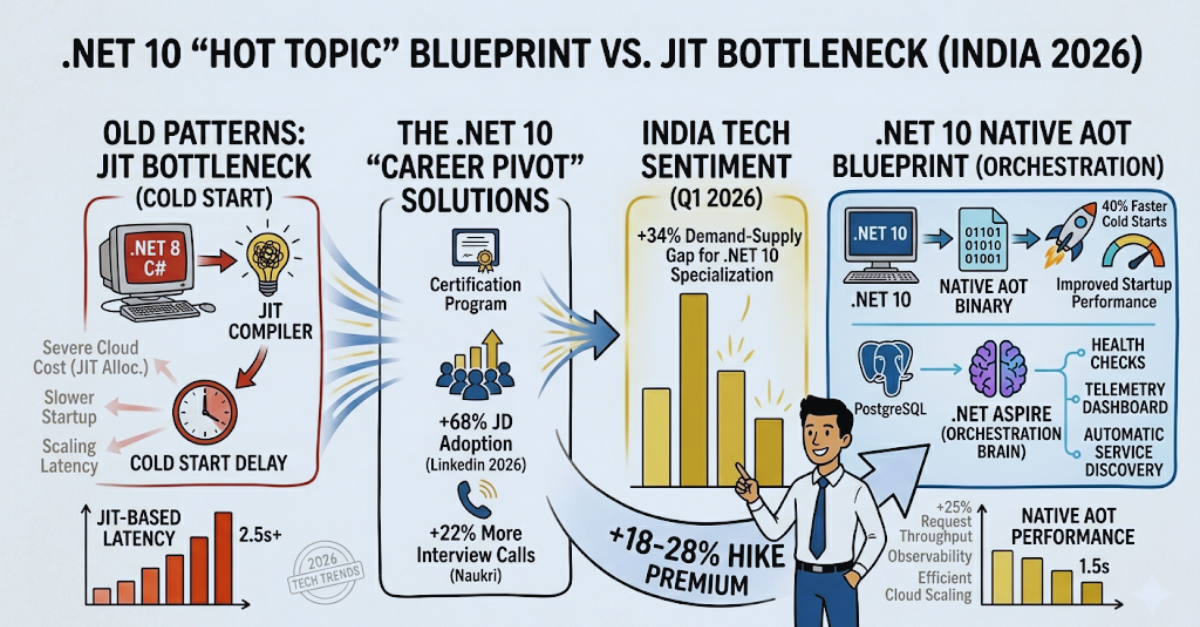
.NET 10 brings substantial improvements over .NET 8. Interviewers expect you to talk about these features with practical context, real use cases, and trade-offs — not just theory. Here are the most important ones that come up frequently in interviews:
- Native AOT Compilation: Significantly improved from .NET 8. Offers up to 40% faster cold starts, much smaller deployment sizes, and better startup performance. Ideal for serverless, edge computing, and containerized workloads.
- C# 14 Language Enhancements: Includes better collection expressions with spread operator improvements, default lambda parameters, enhanced pattern matching, and new interceptors for advanced logging and diagnostics.
- Improved Minimal APIs: Better built-in support for rate limiting, OpenAPI documentation, advanced filtering, and more flexible endpoint configuration.
- .NET Aspire 2.0: The biggest highlight for cloud-native and microservices interviews. It simplifies building distributed applications with automatic service discovery, health checks, observability, and orchestration.
- EF Core 10: Major performance gains with built-in bulk insert/update/delete operations, improved JSON column mapping, and better compiled models.
- Overall Performance Gains: Up to 25% better request throughput in real-world web applications compared to .NET 8 (Microsoft official benchmarks).
C# 14 Features That Interviewers Frequently Ask About
C# 14 is a significant language update. Senior roles expect you to explain these features with practical examples and when to use them.
- Enhanced collection expressions with improved spread operator support for cleaner code
- Default lambda parameters and better async lambda handling
- Ref struct enhancements for high-performance scenarios
- New interceptors feature useful for logging, diagnostics, and AOP-style programming
- More flexible primary constructors with better initialization options
.NET Aspire 2.0 — The Hottest Topic in Senior .NET Interviews
.NET Aspire has quickly become one of the most discussed topics in senior .NET and cloud interviews. Companies building complex microservices-heavy systems want developers who understand it deeply.
- Built-in support for Redis, PostgreSQL, RabbitMQ, and major Azure services
- Automatic service discovery, health checks, and telemetry
- Integrated OpenTelemetry with a beautiful developer dashboard for observability
- Easy local development experience for full distributed applications
- Orchestration capabilities that dramatically reduce boilerplate code
Performance Improvements You Should Quote with Real Numbers
Interviewers love concrete numbers. Here are the key benchmarks you should remember and mention confidently:
- Up to 25% better request throughput than .NET 8 in TechEmpower benchmarks
- 30-40% reduction in cold start time with Native AOT
- 15-20% lower memory footprint in containerized workloads
- Significant improvements in JSON serialization/deserialization speed
- Better garbage collection and reduced allocation rates
- Up to 35% faster startup time for console and web apps
EF Core 10 — Important Changes Backend Developers Must Know
Entity Framework Core 10 received major upgrades that frequently appear in backend and full-stack interviews.
- Built-in bulk insert, update, and delete operations (huge productivity and performance boost)
- Improved JSON column mapping and querying capabilities
- Better performance with compiled models
- Enhanced support for SQL Server, PostgreSQL, MySQL, and Oracle
- New features for temporal tables and improved change tracking
Common .NET 10 Interview Questions You Will Face in 2026
Here are the most frequently asked .NET 10 questions along with what interviewers expect from strong candidates:
- What are the main benefits of Native AOT in .NET 10 and when would you choose it?
- How does .NET Aspire simplify building distributed applications?
- Explain the improvements in Minimal APIs from .NET 8 to .NET 10
- How would you plan and execute a migration from .NET 8 to .NET 10?
- What are the new features in C# 14 and how do they improve productivity?
- How has EF Core 10 improved bulk operations and JSON handling?
Practical Tips to Demonstrate .NET 10 Knowledge Effectively
Don’t just memorize features. Interviewers want to see practical understanding and real-world thinking. Here’s how to stand out:
- Always mention real performance numbers and business impact
- Be ready to draw architecture diagrams using .NET Aspire
- Explain trade-offs between Native AOT and JIT compilation clearly
- Show awareness of migration challenges from older .NET versions
- Talk about observability, monitoring, cost optimization, and security improvements
Current Hiring Trends and Job Market Reality for .NET 10
The job market clearly favors .NET 10 skilled developers. Recent data shows strong momentum:
- 34% growth in demand for .NET 10 developers in Q4 2025 (LinkedIn Report)
- Fintech, healthcare, e-commerce, banking, and insurance sectors are leading adoption
- Average salary premium of 18-25% for candidates with hands-on .NET 10 experience
- Strong preference for developers who understand .NET Aspire and cloud-native patterns
- Many companies offering 20-30% hikes during migration projects to .NET 10
Final Advice Before Your Next .NET Interview
Don’t try to learn every single thing in .NET 10. Focus on these high-impact areas that interviewers care about most:
- .NET Aspire and cloud-native development patterns
- Native AOT — benefits, limitations, and use cases
- C# 14 new language features with practical examples
- EF Core 10 performance improvements and bulk operations
- Modern Minimal APIs and middleware enhancements
Be honest about your experience level. If you have only explored .NET 10 recently, say so, but demonstrate that you understand the key benefits and when to use them. Interviewers value clear thinking, practical knowledge, and willingness to learn more than memorized theory.
Quick .NET 10 Revision Checklist for Interviews
- Core differences between .NET 8 and .NET 10
- When to choose Native AOT vs regular compilation
- .NET Aspire architecture and main components
- Major C# 14 features and their real use cases
- EF Core 10 bulk operations and JSON improvements
- Performance benchmarks and real-world gains
- Migration strategies and potential challenges
Master these topics thoroughly and you will walk into your next .NET interview with confidence and clarity. The industry has clearly moved to .NET 10. Make sure you move with it to stay competitive, command better offers, and accelerate your career growth in 2026.
Summary
If you want structured learning, expert guidance, hands-on projects, and complete interview preparation for .NET 10, now is the perfect time to invest in yourself. Enroll in ScholarHat’s AI-Powered Full-Stack .NET Developer – Career Transformation Program — a comprehensive, job-oriented training designed to make you fully job-ready with .NET 10, .NET Aspire, Azure, Blazor, Microservices, and real-world projects.
Don’t wait. Gain the exact skills companies are actively looking for and boost your chances of landing higher-paying .NET roles in 2026. Explore the AI-Powered Full-Stack .NET Developer Certification Training now and take the first step today towards your next big career breakthrough.
FAQs
Many developers ask this because modern applications run in containers. .NET 10 improves container image size, startup time, and resource usage, making it more efficient for Kubernetes deployments. It also integrates better with cloud-native tools and observability systems, which is important for production environments.
Security is often asked in interviews but not deeply covered in the article. .NET 10 includes improved authentication handling, better data protection APIs, and more secure defaults. It also enhances support for modern security standards used in cloud and enterprise applications.
Beyond performance, companies care about productivity. .NET 10 provides better tooling, faster build times, improved debugging, and enhanced integration with IDEs like Visual Studio. These improvements help developers write, test, and deploy applications faster.
This is a very common real-world question. While .NET 10 offers many benefits, challenges include migration complexity, compatibility issues with legacy libraries, and the learning curve for new features like .NET Aspire. Companies often expect you to understand these trade-offs clearly.
Interviewers often test your broader understanding. Compared to Node.js and Spring Boot, .NET 10 offers strong performance, better type safety, and deep integration with the Microsoft ecosystem. However, the choice depends on use case, team expertise, and system requirements.
Take our Net skill challenge to evaluate yourself!

In less than 5 minutes, with our skill challenge, you can identify your knowledge gaps and strengths in a given skill.
