
Most .NET developers are still comfortable with the traditional MVC pattern they learned years ago, but today, interviewers and companies are actively comparing minimal api vs controller. Many developers get confused when asked which architecture they would choose for a new project. If you’re preparing for interviews or planning a new application, understanding the real differences between minimal APIs and controllers can significantly impact your career growth, project success, and salary potential.
minimal api vs controller: which architecture wins?
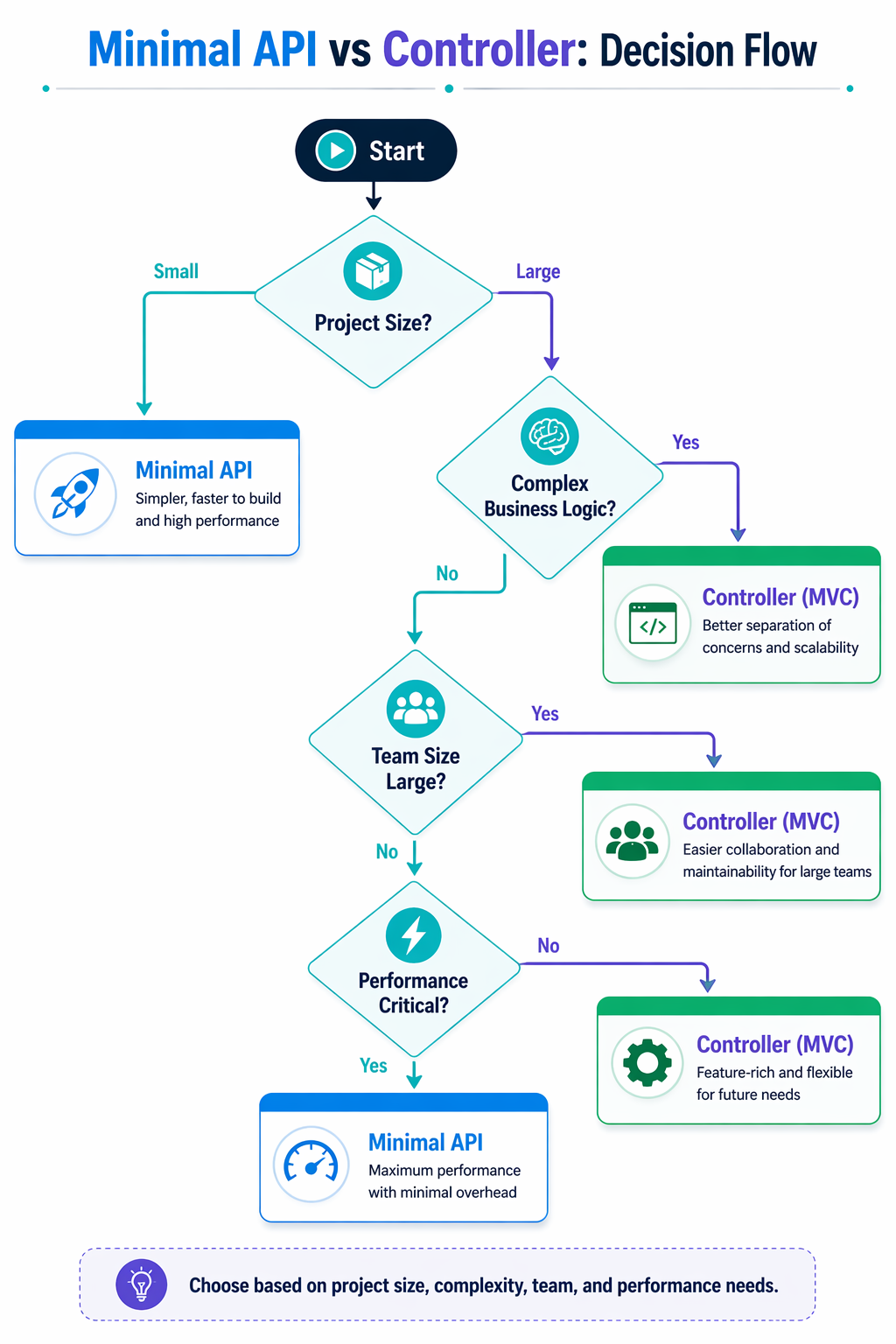
The debate between minimal APIs and controllers has become more important as modern applications demand better performance, scalability, and faster development cycles. Minimal APIs focus on simplicity and speed, while controllers provide a structured and layered architecture. There is no single winner for every situation. Instead, the right choice depends on your project size, team experience, performance requirements, and long-term maintenance strategy.
Core Concept Difference
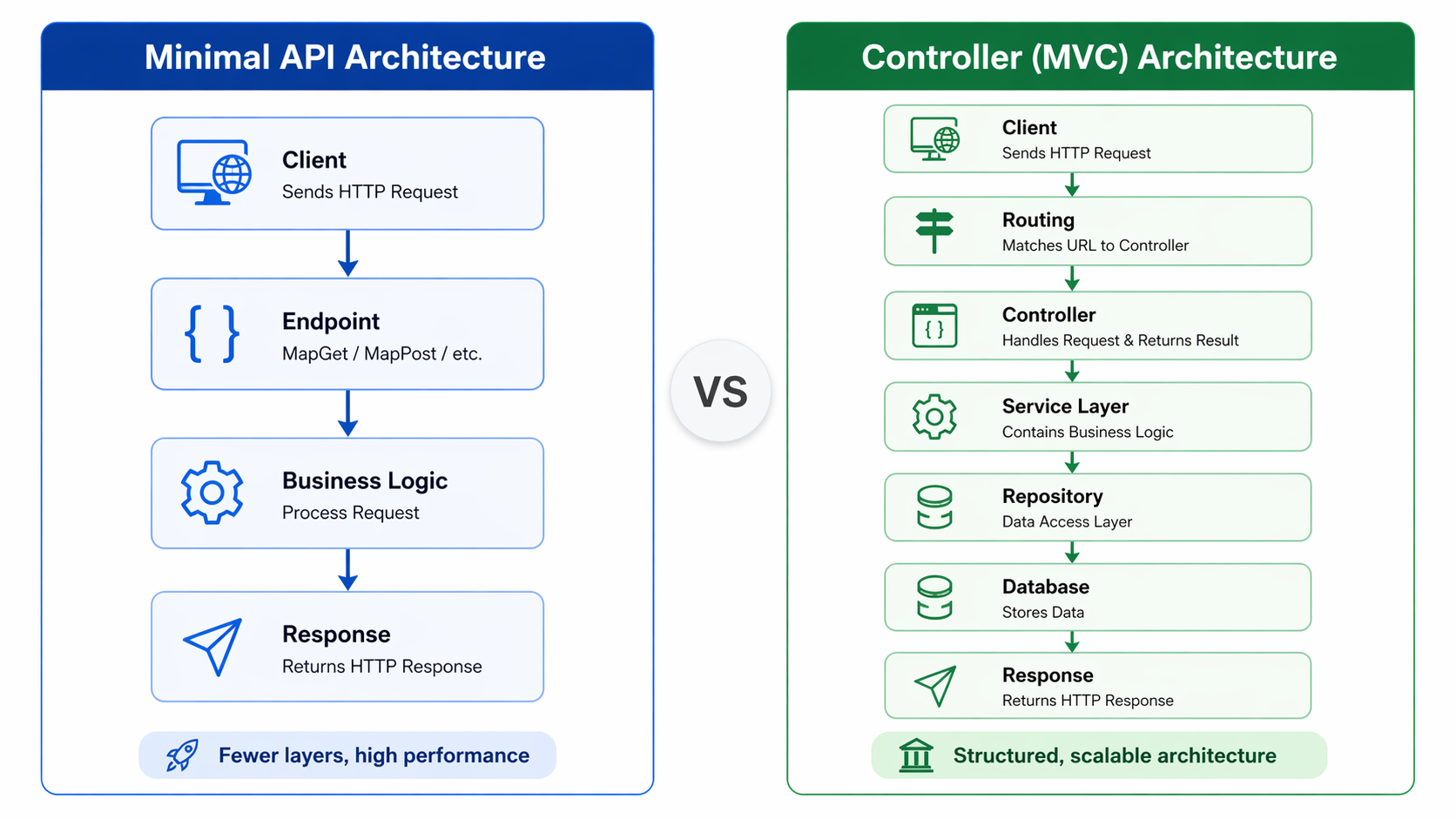
The main difference between minimal APIs and controllers lies in how you design and structure your application. Minimal APIs allow you to define endpoints directly with minimal configuration, while controllers follow a predefined MVC structure that separates responsibilities into different layers.
- Minimal API focuses on simplicity and direct endpoint mapping
- Controller follows a structured MVC pattern
- Minimal API reduces abstraction layers
- Controller enforces separation of concerns
Quick Comparison: minimal api vs controller
| Factor | Minimal API | Controller |
| Development Speed | Very fast with minimal setup | Slower due to structured files |
| Performance | High throughput and low latency | Stable but slightly heavier |
| Memory Usage | Lower memory footprint | Higher memory usage |
| Code Size | Less code required | More boilerplate code |
| Scalability | Great for microservices | Great for large applications |
| Maintainability | Depends on structure used | Built-in structured approach |
Performance Reality Check
Performance is one of the biggest reasons why minimal APIs are gaining popularity. By removing unnecessary middleware layers and reducing processing overhead, minimal APIs can handle more requests with fewer resources. This becomes critical in high-traffic systems and cloud-based deployments.
- 20–35% higher request throughput in many benchmarks
- 15–25% lower memory usage compared to controllers
- Faster startup time in containerized environments
- Lower latency for API responses
- Reduced infrastructure and cloud costs
- Better performance in serverless environments
Architecture and Design Flexibility
Minimal APIs give you complete flexibility in how you organize your code. You can design your own structure based on project needs. However, this flexibility comes with responsibility. Without proper organization, the code can become difficult to manage.
Controllers follow a predefined architecture that separates models, views, and controllers. This makes it easier to maintain large projects and ensures consistency across teams.
Scalability and System Design
Minimal APIs are well-suited for microservices architecture, where each service is independent and lightweight. Controllers work better in monolithic or modular systems where different layers interact closely.
- Minimal APIs support horizontal scaling in distributed systems
- Controllers support vertical scaling in large applications
- Minimal APIs are ideal for cloud-native design
- Controllers are ideal for enterprise architecture
Real-World Use Cases
Understanding where each approach fits helps you make better decisions.
- Minimal API is used in microservices, APIs, and backend services
- Controllers are used in enterprise systems and web applications
- Minimal APIs are preferred for startup projects
- Controllers are preferred in large organizations
Code Example: minimal api vs controller
Here you can see how the same API endpoint looks in both approaches. This helps you clearly understand the difference in structure and complexity.
Minimal API Example
// Program.cs

var builder = WebApplication.CreateBuilder(args);

var app = builder.Build();

// In-memory data
var users = new List<string>
{
    "Shailesh",
    "Pradnya",
    "Aman"
};

// GET all users
app.MapGet("/users", () => users);

// GET user by id
app.MapGet("/users/{id}", (int id) =>
{
    if (id < 0 || id >= users.Count)
        return Results.NotFound("User not found");

    return Results.Ok(users[id]);
});

// POST add user
app.MapPost("/users", (string name) =>
{
    users.Add(name);
    return Results.Ok("User added successfully");
});

app.Run();
- Very less setup and minimal configuration
- All endpoints defined in a single file
- Faster development and quick iteration
- Best suited for small APIs and microservices
Controller Example
// UsersController.cs

using Microsoft.AspNetCore.Mvc;

[ApiController]
[Route("api/[controller]")]
public class UsersController : ControllerBase
{
    private static List<string> users = new List<string>
    {
        "Shailesh",
        "Pradnya",
        "Aman"
    };

    // GET: api/users
    [HttpGet]
    public IActionResult GetUsers()
    {
        return Ok(users);
    }

    // GET: api/users/1
    [HttpGet("{id}")]
    public IActionResult GetUser(int id)
    {
        if (id < 0 || id >= users.Count)
        {
            return NotFound("User not found");
        }

        return Ok(users[id]);
    }

    // POST: api/users
    [HttpPost]
    public IActionResult AddUser([FromBody] string name)
    {
        users.Add(name);
        return Ok("User added successfully");
    }
}
// Program.cs

var builder = WebApplication.CreateBuilder(args);

// Add controller services
builder.Services.AddControllers();

var app = builder.Build();

// Map controllers
app.MapControllers();

app.Run();
- Follows structured MVC architecture
- Separates logic into different files
- Better for large and complex applications
- Improves long-term maintainability
Code Complexity and Maintenance
Minimal APIs reduce code complexity in small projects but can become harder to manage in large systems without proper structure. Controllers provide a clear organization that improves long-term maintainability.
- Minimal APIs reduce initial complexity
- Controllers reduce long-term complexity
- Minimal APIs require custom structure
- Controllers provide built-in structure
Developer Productivity
Minimal APIs allow developers to build features quickly because they eliminate boilerplate code. This improves productivity, especially in small teams and startups. Controllers improve productivity in large teams by enforcing consistency.
- Faster development cycles with minimal APIs
- Better team collaboration with controllers
- Easier onboarding with minimal APIs
- Better maintainability with controllers
Security and Validation
Both approaches support modern security practices such as authentication and authorization. Controllers provide built-in validation mechanisms, while minimal APIs require more explicit configuration.
- Supports JWT and OAuth authentication
- Controllers use attribute-based validation
- Minimal APIs use manual validation setup
- Both support middleware-based security
Testing and Debugging
Testing is easier in controllers due to their structured design. Minimal APIs can also be tested effectively, but they require additional setup for proper separation of concerns.
- Controllers support unit testing naturally
- Minimal APIs need custom testing patterns
- Debugging is easier in structured code
- Minimal APIs require disciplined coding practices
When minimal API clearly wins
Minimal APIs have matured significantly and are now the preferred choice in many modern scenarios:
- Building lightweight microservices and backend APIs
- Serverless applications
- High-performance public APIs
- Startups and fast-moving teams
- Rapid prototyping and quick iterations
- Projects focused on reducing infrastructure costs
Most new API-focused projects today are being built using minimal APIs because of their simplicity and performance benefits.
When controller still dominates
Controllers are far from obsolete. They remain the preferred choice in several important cases:
- Large-scale enterprise applications
- Applications with complex business logic
- Projects requiring strong structure and conventions
- Legacy systems and long-term maintained applications
- Applications using server-side rendering
- Domains like banking, insurance, and government systems
Many organizations still choose controllers for their structured architecture and team collaboration benefits.
Hybrid Approach
Many modern applications use a hybrid approach to combine the strengths of both minimal APIs and controllers. This strategy allows teams to optimize performance while maintaining structure where needed.
Instead of choosing one over the other, you can design your system in a way that uses each approach where it fits best.
- Use minimal API for backend services: Ideal for microservices, public APIs, and lightweight endpoints.
- Use controller for complex modules: Best suited for areas with complex business logic and structured workflows.
- Combine both for flexibility and performance: This approach ensures faster development without sacrificing maintainability.
- Adopt modular architecture: Different parts of the same application can use different patterns based on their requirements.
Migration Strategies
Migrating from controllers to minimal APIs does not require a complete rewrite. A gradual and strategic approach works best to avoid risks and maintain system stability.
- Gradually migrate endpoints: Start by converting smaller or less critical endpoints to minimal APIs.
- Keep controllers for existing features: Avoid unnecessary changes to stable parts of your application.
- Use minimal APIs for new services: New modules can be built using minimal APIs without affecting existing architecture.
- Focus on performance-critical areas: Convert only those endpoints where performance improvement is needed.
- Refactor step by step: Continuously improve structure while migrating instead of doing everything at once.
Industry Trends and Adoption
The industry is evolving toward modern architectures that prioritize performance and scalability. Both minimal APIs and controllers are widely used, but their adoption depends on the type of organization and project.
- Modern startups prefer minimal APIs: Startups focus on speed and cost, making minimal APIs a natural choice.
- Enterprises continue using controllers: Large organizations rely on controllers for structured and maintainable systems.
- Cloud applications are shifting toward minimal APIs: Cloud-native design favors lightweight and scalable architectures.
- Full-stack developers are expected to know both: Having knowledge of both approaches increases job opportunities and flexibility.
- Hybrid architecture is becoming common: Many companies combine both approaches to achieve better results.
Common Interview Questions
Interviewers often ask practical and scenario-based questions to test your understanding of minimal APIs and controllers.
- When would you choose minimal API over controller? Explain based on performance, simplicity, and project size.
- What are the performance benefits of minimal APIs? Focus on reduced overhead and faster request handling.
- Can minimal APIs replace controllers? Discuss limitations and when controllers are still required.
- How do you structure large applications? Talk about layering, modular design, and hybrid approach.
- What are the trade-offs? Compare flexibility vs structure, speed vs maintainability.
- How would you migrate an existing system? Explain gradual migration strategies with real scenarios.
Summary
Minimal APIs are growing rapidly due to their simplicity and performance advantages. Controllers remain essential for structured and enterprise-level applications.The smartest approach is to learn both and apply them strategically.
Don’t wait. Gain the exact skills companies are actively looking for and boost your chances of landing higher-paying .NET roles. Explore the AI-Powered Full-Stack .NET Developer Certification Training now and take the first step today towards your next big career breakthrough.