Demo: Interview Problems on Global and Local Variable
14m 28s
Data Types
Data Types
04m 13s
Demo: Data Type
09m 51s
Demo: Size of Data Types
03m 14s
Operators
Operators
01m 20s
Demo: Uninary Operators
16m 46s
Arithimetic operator
07m 36s
Relational operator
06m 11s
If Else
If else
05m 26s
Demo: If
10m 09s
Demo: If Else
21m 23s
Switch Statement
Switch statement
02m 02s
demo: Switch statement
07m 23s
Loop
Loop
04m 22s
While Loop
24m 36s
Demo: Do While Loop
07m 29s
Demo: For Loop
15m 11s
Jump Statement
Jump Statements
02m 17s
Demo: Jump Statement
22m 43s
Arrays
Course Overview
04m 08s
Demo: Array
21m 32s
Array Types
01m 56s
Demo: Single and Multidimensional Array
24m 50s
Insertion and Deletion in an Array
04m 25s
Demo: Passing Array to Function and Pointers
18m 21s
Pointers
Pointers
09m 01s
Demo: Pointers1
24m 23s
Demo: Arithmetics on pointer
19m 47s
Demo Pointer to Pointer
05m 52s
Demo: Array and Pointer
07m 47s
Pointer to Function
06m 10s
Demo: Dynamic Memory Allocation
06m 53s
Demo: Malloc Relloc, Calloc
26m 33s
1. Introduction to C
00:05:00
2. Variables in C
00:03:00
3. Data Types in C
00:03:00
4. Operators in C
00:02:00
5. Bitwise Operators in C
00:01:00
6. Conditional Statements in C
00:05:00
7. Loops in C
00:05:00
8. Jump Statements in C
00:03:00
9. Nested Loops in C
00:02:00
10. Arrays in C
00:04:00
11. Pointers in C
00:04:00
12. Memory Management in C
00:02:00
1. C:Check Character Is Alphabet or Not
00:10:00
2. C: Calculate the Area of a Square
00:10:00
3. C: Sum of All Numbers
00:10:00
4. C:Check if a Number Is Even or Odd
00:10:00
5. C:Check Number Is Positive or Negative
00:15:00
6. C: Swap Number Without Third Variable
00:10:00
7. C: Swap Number with Second Variable
00:10:00
8. C:Check Whether an Alphabet Is Vowel or Consonant
00:15:00
9. C: Find the Largest Number among the Four Numbers
00:15:00
10. C: Check Whether a Year Is Leap Year or Not
00:15:00
11. C: Display the Fibonacci Series
00:15:00
12. C:Find the Highest Common Factor (HCF) or Greatest Common Factor (GCD)
00:15:00
13. C: Find the Factorial of a Number
00:15:00
14. C: Find the Lowest Common Multiple Factor (LCM)
00:15:00
15. C: Check whether a Number is Palindrome or Not
00:15:00
16. C: Check whether a Number Is Armstrong Or Not
00:20:00
17. C: Check whether a Number Is Prime or Not
00:20:00
18. C: Count the Vowel and Consonants in A Sentence
00:20:00
19. C: To Make A Calculator for Addition Subtraction Multiplication and Division of Two Numbers
00:20:00
20. C: To Print a table of a number
00:15:00
21. C: Right Triangle Star Pattern
00:15:00
22. C: Left Triangle Star Pattern
00:15:00
23. C: Pyramid Star Pattern
00:15:00
24. C: Diamond Star Pattern
00:15:00
25. C: Right Triangle Number Pattern (Desc)
00:15:00
26. C: Right Triangle Repeat Number Pattern
00:15:00
27. C: Pyramid Number Pattern (Asc)
00:15:00
28. C: Pyramid Number Pattern (Desc)
00:15:00
29. C: Pyramid Repeat Number Pattern
00:15:00
30. C: Inverted Right Triangle Number Pattern (Asc)
00:15:00
31. C: Inverted Right Triangle Number Pattern (Desc)
00:15:00
32. C: Right Triangle Number Pattern (Asc)
00:15:00
33. C: Right Triangle Number Pattern (Desc)
00:15:00
34. C: Diamond Number Pattern
00:15:00
35. C: Right Triangle Alphabetic Pattern
00:15:00
36. C:Right Triangle Repeat Alphabet Pattern
00:15:00
37. C:Pyramid Alphabet Pattern (Asc)
00:15:00
38. C: Pyramid Alphabet Pattern (Desc)
00:15:00
39. C: Pyramid Repeat Alphabet Pattern
00:15:00
40. C: Inverted Right Triangle Alphabet Pattern
00:15:00
41. C: Diamond Alphabet Pattern
00:15:00
Free C Course Overview
Scholarhat’s C Language Free Course is a beginner-friendly gateway to powerful programming. With self-paced modules, you’ll master C basics, variables, functions, arrays, pointers, and more through engaging videos, hands-on labs, and interactive quizzes in this C programming language online course free. Perfect for those searching for “C language free course” or “C programming tutorial for beginners.”
Key Skills You'll Master in This Free C Programming Course
At the completion of this course, attendees will be able to:
Introduction to C: Learn C basics, Hello World program, scanf/printf, variables, and literals.
Data Types and Operators: Understand data types, sizes, unary, arithmetic, and relational operators.
Conditional Statements and Loops: Master if-else, switch, for, while, and do-while control structures.
Arrays and Pointers: Handle arrays, pointers, memory allocation, and dynamic memory management.
Functions: Learn about defining functions, recursion, parameters, and modular program design.
Union, Structure, and Enum: Explore structs, unions, and enums for advanced data handling.
Why Learn C Programming?
Foundation for Other Languages: C is the foundation for languages like C++, Java, and Python.
Used in Systems Programming: It's used in systems programming and high-performance applications.
Speed and Efficiency: Known for speed and efficiency, ideal for game development.
Improves Skills: Enhances problem-solving, memory management, and debugging skills.
Career Opportunities: Opens up job opportunities and ensures code portability.
Features
Course Features: Free C Programming Certification Course
Beginner-Friendly Curriculum: Designed for people new to programming, this curriculum covers the essential concepts of C in a simple and approachable manner.
Structured Learning Path: Work through well-organised modules to gain a strong grasp step by step.
Video Lectures and Interactive Lessons: Engaging video content combined with hands-on coding tasks to promote practical learning.
Core Topics Covered: Understand fundamental concepts like as variables, data types, control structures, functions, arrays, pointers, and memory management.
Real-world Applications: Exercises and examples based on real-world programming tasks allow you to put what you've learnt to use instantly.
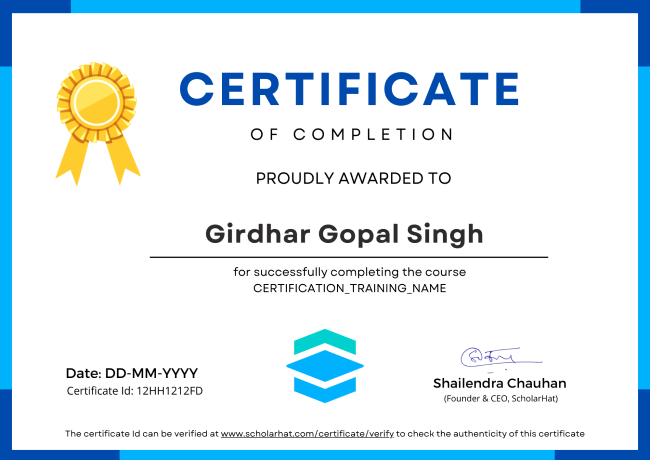
Free Certification: Receive a certificate upon successful completion to showcase your skills and enhance your resume.
Flexible, Self-Paced Learning: You can access course materials at any time and learn at your speed.
Tools for Learning C Programming
Code Editor: Try Visual Studio Code or Sublime Text for efficient code writing.
IDE: Use Code::Blocks or Dev-C++ for a full coding and debugging environment.
Compiler: GCC or Clang to compile and execute your C programs.
Debugger: GDB for identifying and fixing code errors.
Online Platforms: Practice on Scholarhat or HackerRank for hands-on coding.
Version Control: Git (optional) for tracking code changes as you progress.
Top Career Options After Learning C Programming
Software Developer: Build and manage software, often for embedded systems.
Embedded Systems Engineer: Develop software for consumer electronics and medical devices.
Systems Programmer: Create low-level programs like OS and drivers.
Game Developer: Use C for high-performance, memory-efficient games.
Firmware Engineer: Design and improve firmware for hardware operations.
R&D Engineer: Work on high-performance computing in AI, robotics, and data science.
Eligibility Criteria for Learning the C Programming Course
There are no specific eligibility requirements to take this C Programming course. It is designed for beginners, so anyone with an interest in learning programming is welcome to enroll. However, having basic computer literacy and familiarity with how to use a computer and the internet can help you get started. A logical mindset and problem-solving interest will also be beneficial as you learn programming concepts.
Are there any hidden charges for the certification? No, the course and certification are completely free. There are no hidden charges.
How can I get the free certification? To get the free certification, you need to enroll in the course, complete all the required modules, and pass the final assessment or quiz
Can I earn multiple free certifications? Yes, you can enroll in multiple courses and earn free certifications for each course you successfully complete.
Will the certification mention that the course was free? No, the certification will only highlight your achievement and not mention whether the course was free or paid.
Hear it from our learners
Real stories from people who trained with ScholarHat.

This beginner-friendly course covers variables, data types, operators, control structures, functions, arrays, pointers, memory management, and more—providing a comprehensive foundation in C programming.
Yes, the course is 100% free, including access to all video lectures, hands-on labs, quick notes, and a certificate upon successful completion.
Absolutely! Upon finishing all modules and passing the final quiz, you'll earn a free certificate from ScholarHat to showcase your skills.
The course is structured to be completed in 21 days, but it's self-paced, allowing you to learn at your convenience.
Learning C programming opens up opportunities in software development, embedded systems, game development, and more. It's a foundational skill valued in various tech roles.
Yes! All our listed courses are completely free. You can access all learning materials, videos, and resources without paying a single rupee.
Anyone! Whether you're a beginner with no coding experience or someone looking to upskill, our courses are designed for all levels.
Absolutely. Every course includes step-by-step guidance, real-life examples, and practice projects to help you learn effectively from scratch.
Yes, all our courses are fully self-paced. You can learn anytime, anywhere, and from any device that suits you.
Our focus is on job-ready skills. The courses are built to teach industry-relevant knowledge that employers value, including hands-on coding and real-world projects.
Yes! Along with courses, we offer career resources like interview prep eBooks, resume tips, and mock interview support.
While free courses provide strong fundamentals, combining them with real-world projects, internships, and advanced practice can significantly boost your chances of landing a job.